
What is a 3-Day Workout Split?
A 3-day split is a workout plan where you train three times a week. The purpose of a 3-day split is to do enough direct training for major muscles through a combination of compound and isolation exercises. A 3-day split typically involves training multiple muscle groups in each workout, but can also be a full-body plan.
Given the relatively low frequency, it can be a great balance between results and time efficiency if you don’t want to or can’t make it to the gym four, five, or six days per week.
Such a split is particularly beneficial for beginners since they don’t need as much training to see great results. Plus, it’s not as difficult to stay consistent. Four days off give your body enough time to recover, repair muscle damage, get stronger, and reduce the risk of injury or overtraining.
With a traditional beginner 3-day split, you will mostly work a specific muscle group once a week, leaving 7 days of recovery for that group. If you want a more advanced workout plan with high-volume training, we have German volume training, the Arnold split, and 5-day, 6-day, and 7-day workout plans.
That said, don’t automatically assume that a higher training frequency = better results. Often, even a simple, low-volume routine can lead to great results if you stick with it and train hard enough.
Key Takeaways
- Popular 3-day split options include bodybuilder/bro splits, push/pull/legs, upper/lower/upper, and full-body.
- Full-body is a great 3-day option because it makes it easier to train each muscle and can lead to better symmetry. However, push/pull/legs and other options can also work, so long as you plan each workout accordingly.
- You can follow a 3-day split with a few pieces of equipment, such as a pair of adjustable dumbbells, a barbell, plates, a bench, resistance bands, and a pull-up bar.
- A 3-day split is a great option for anyone looking to build muscle, get stronger, or get leaner. It’s a viable option even for more advanced trainees who can’t work out more often.
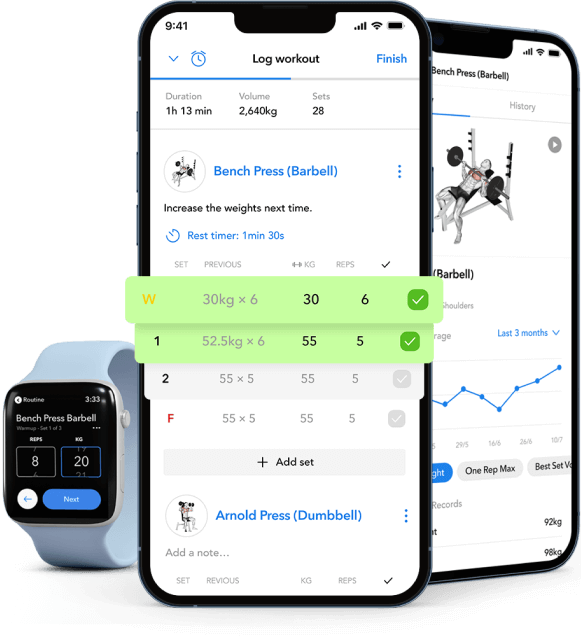
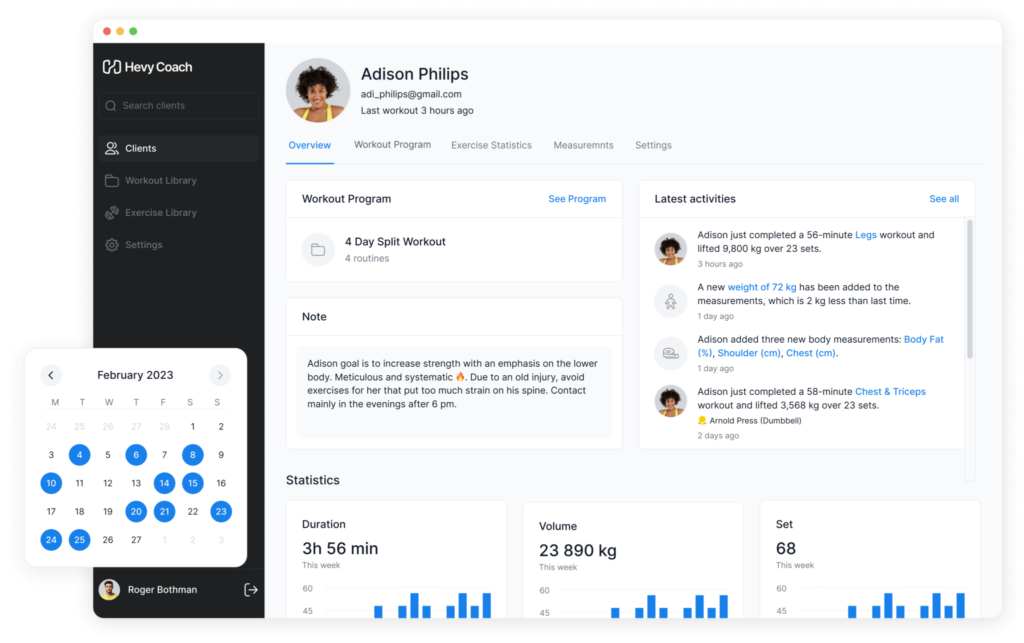
- Hevy is the perfect workout tracker for your 3-day split because you can store routines, log workouts with ease, change training variables at any time, and track your gym and body composition progress.


What are Popular 3-Day Workout Splits for Muscle Gain?
Classic 3-Day Bodybuilder Split
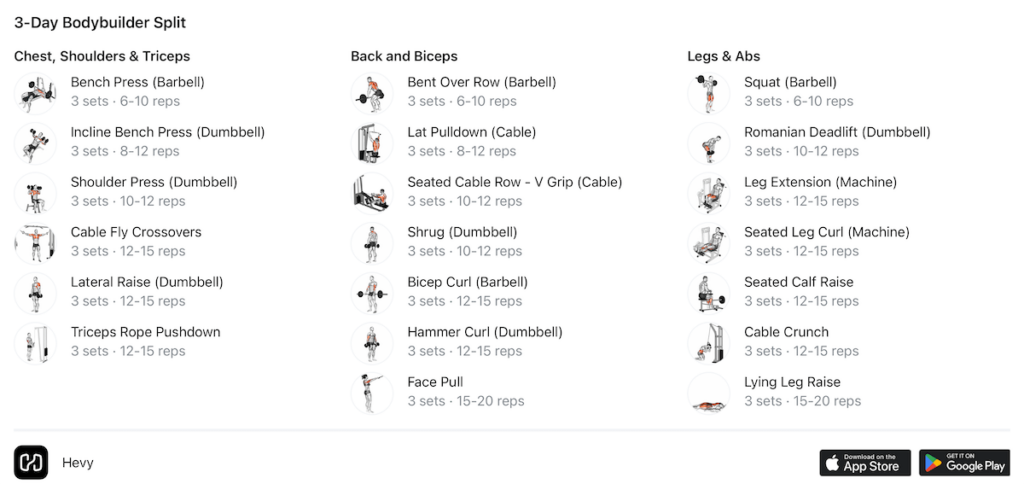
This is one of the most popular workout splits where you train two to three major muscle groups in each session:
Workout 1: Chest, shoulders & triceps
Workout 2: Back and biceps
Workout 3: Legs and abs
Since there are three workouts for the week, you can take a rest day between them and even take the weekend off to recover and do other things. Here is an example of how you could schedule your week with the classic 3-day bodybuilder split:
Monday: Chest, shoulders & triceps
Tuesday: Rest day
Wednesday: Back and biceps
Thursday: Rest day
Friday: Legs and abs
Saturday: Rest day
Sunday: Rest day
Let’s jump into a little more detail with sample workouts. Note: These workouts only include the working weight sets. We always recommend you warm up properly for each exercise. To learn more about warm-up sets, click here.
Chest, Shoulders & Triceps
- Bench Press (Barbell) – 3 sets (6-10 reps)
- Incline Bench Press (Dumbbell) – 3 sets (8-12 reps)
- Shoulder Press (Dumbbell) – 3 sets (10-12 reps)
- Cable Crossover Fly – 3 sets (12-15 reps)
- Lateral Raise (Dumbbell) – 3 sets (12-15 reps)
- Triceps Rope Pushdown – 3 sets (12-15 reps)
Back and Biceps
- Bent Over Row (Barbell) – 3 sets (6-10 reps)
- Lat Pulldown (Cable) – 3 sets (8-12 reps)
- Seated Cable Row – V Grip (Cable) – 3 sets (10-12 reps)
- Shrug (Dumbbell) – 3 sets (10-12 reps)
- Bicep Curl (Barbell) – 3 sets (12-15 reps)
- Hammer Curl (Dumbbell) – 3 sets (12-15 reps)
- Face Pull – 3 sets (15-20 reps)
Legs & Abs
- Squat (Barbell) – 3 sets (6-10 reps)
- Romanian Deadlift (Dumbbell) – 3 sets (10-12 reps)
- Leg Extension (Machine) – 3 sets (12-15 reps)
- Seated Leg Curl (Machine) – 3 sets (12-15 reps)
- Seated Calf Raise – 3 sets (12-15 reps)
- Cable Crunch – 3 sets (12-15 reps)
- Leg Raise variation – 3 sets (15-20 reps)
Adjust the reps and weights to your capacity and fitness level. The rest times between sets will depend on your training objectives and the difficulty of each set. As a general rule, we recommend resting for 1:30 to 3 minutes between sets.
The Hevy app has an automatic rest timer that triggers when you mark a set as completed––learn about it here.
If you’re just starting, be careful not to start too heavy. Gaining muscle is a marathon, not a sprint, and you won’t be able to make any gains if you’re injured.
Bonus: If you still have energy left on the weekend, get some cardio in your workout split. Aim for at least 30 minutes of low-intensity activity, whether running, rowing, biking, or similar.
Push/Pull/Legs 3-Day Split
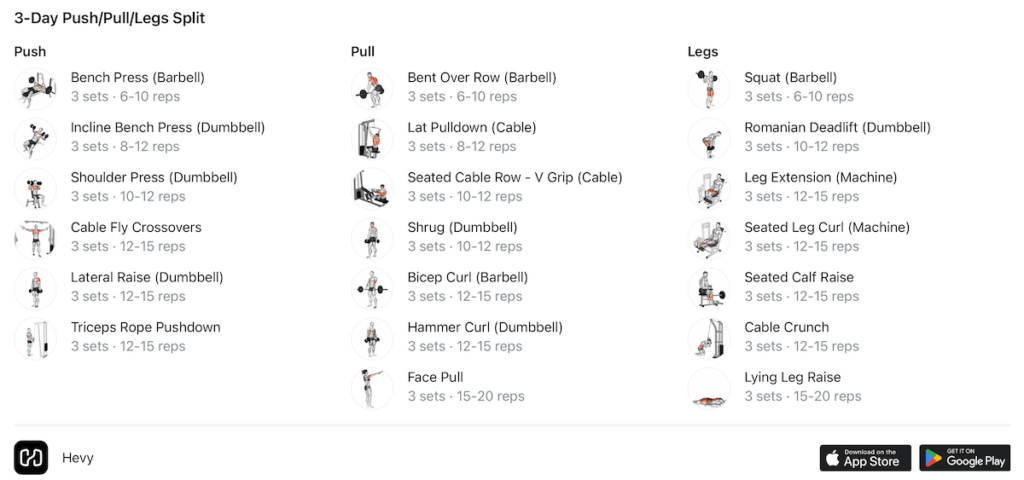
(Click here and tap the blue Save Folder button to save this split to your Hevy profile.)
Push/pull/legs is another effective way to organize a 3-day split. Unlike the classic 3-day split, it doesn’t split the workout sessions by targeted muscles, but rather by the different types of movements you have to perform.
It generally means workouts look identical, but the method used to program them differs slightly. Neither approach is better or worse; it mostly comes down to personal preference and how you want to organize your workouts.
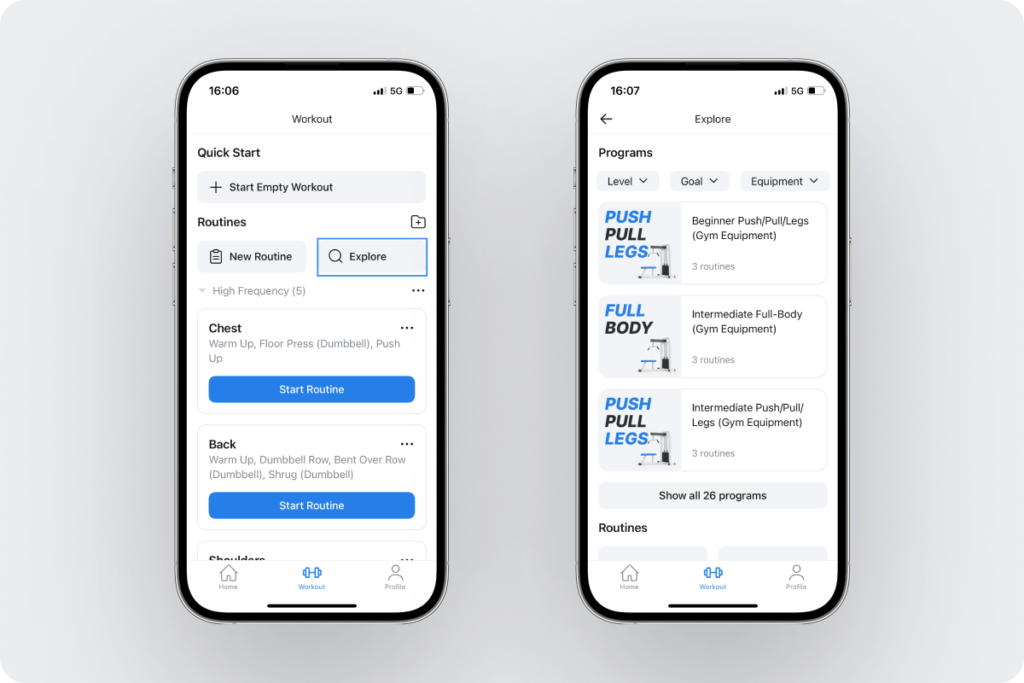
If you want to quickly create workouts, we recommend trying Hevy. You can easily create a personalized workout split and track your progress for free. Need some inspiration? Browse the routine library (Workout tab > Explore) for 25+ training plans for all levels.
In the push workout, you train the upper-body pushing muscles: chest, triceps, and shoulders. In the pull workout, you train all the upper-body pulling muscles: the back and the biceps. In the legs workout, you train the lower body: quads, hamstrings, glutes, and calves.
Many athletes also add abs training on leg day, so they don’t need a fourth workout.
Here’s an example of a push/pull/legs weekly schedule:
Monday: Push
Tuesday: Rest day
Wednesday: Pull
Thursday: Rest day
Friday: Legs
Saturday: Rest day
Sunday: Rest day
As you can see, it’s the same schedule as for a classic 3-day bodybuilding split. You can also train on Tuesday, Thursday, and Saturday, as well as:
- Monday-Tuesday-Thursday
- Monday-Wednesday-Thursday
- Tuesday-Wednesday-Thursday
Doing fewer workouts gives you greater scheduling flexibility and lets you train on consecutive days when your schedule gets hectic or unpredictable. That said, it’s generally best to get at least a day of recovery between sessions for optimal performance.
Let’s now look at some sample workouts:
Push
- Bench Press (Barbell) – 3 sets (6-10 reps)
- Incline Bench Press (Dumbbell) – 3 sets (8-12 reps)
- Shoulder Press (Dumbbell) – 3 sets (10-12 reps)
- Cable Crossover Fly – 3 sets (12-15 reps)
- Lateral Raise (Dumbbell) – 3 sets (12-15 reps)
- Triceps Rope Pushdown – 3 sets (12-15 reps)
Pull
- Bent Over Row (Barbell) – 3 sets (6-10 reps)
- Lat Pulldown (Cable) – 3 sets (8-12 reps)
- Seated Cable Row – V Grip (Cable) – 3 sets (10-12 reps)
- Shrug (Dumbbell) – 3 sets (10-12 reps)
- Bicep Curl (Barbell) – 3 sets (12-15 reps)
- Hammer Curl (Dumbbell) – 3 sets (12-15 reps)
- Face Pull – 3 sets (15-20 reps)
Legs
- Squat Barbell – 3 sets (6-10 reps)
- Romanian Deadlift (Dumbbell) – 3 sets (10-12 reps)
- Leg Extension (Machine) – 3 sets (12-15 reps)
- Seated Leg Curl (Machine) – 3 sets (12-15 reps)
- Seated Calf Raise – 3 sets (12-15 reps)
- Cable Crunch – 3 sets (12-15 reps)
- Lying Leg Raise – 3 sets (15-20 reps)
Don’t forget that consistency is the secret sauce in the gym. Stick to a routine for at least two months and eat according to your goal: a slight surplus with adequate protein intake for growth, or a small deficit with enough protein for fat loss, to see results.
Also, take progress photos and circumference measurements regularly and weigh yourself a few times each week to track your average. The Hevy app lets you upload all these metrics, display them in graphs, and compare your progress photos to track your body composition.
Upper/Lower 3-Day Split
(Click here and tap the blue Save Folder button to save this split to your Hevy profile.)
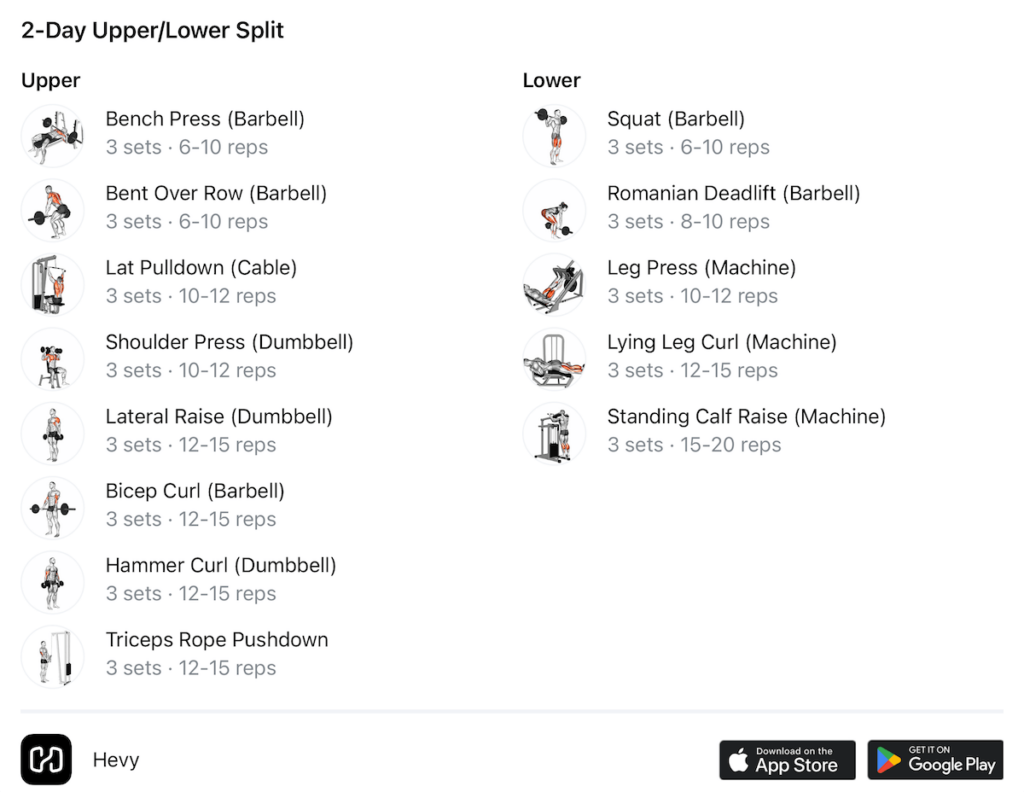
The upper/lower workout split differs slightly from previous approaches. That is because it divides the target muscles into two sessions instead of three.
The upper workout targets all the muscles in the upper body, including the chest, shoulders, triceps, back, biceps, forearms, and midsection. The lower workout targets muscles below the waist, including the quadriceps, hamstrings, glutes, adductors, and calves.
This workout split can still be considered a 3-day one, since you can alternate your sessions as follows.
Week 1: upper/lower/upper
Week 2: lower/upper/lower
… and so on. So your bi-weekly schedule could look like this.
Week 1
Monday: Upper
Tuesday: Rest day
Wednesday: Lower
Thursday: Rest day
Friday: Upper
Saturday: Rest day
Sunday: Rest day
Week 2
Monday: Lower
Tuesday: Rest day
Wednesday: Upper
Thursday: Rest day
Friday: Lower
Saturday: Rest day
Sunday: Rest day
So, how is the upper/lower workout split different? To begin with, it’s simpler because you are always alternating between two workouts. If you like to keep things simple, this might be the workout split for you.
Another notable difference from the push/pull/legs workout split is that, instead of dividing the upper body into push and pull, all upper-body muscles are worked in the same session. For example, day 1 on such a 3-day split can start with compound lifts like the bench press, barbell row, overhead press, and pull-ups.
Below is a sample upper/lower workout split with a great combination of exercises for maximum muscle gain.
Upper
- Bench Press (Barbell) – 3 sets (6-10 reps)
- Bent Over Row (Barbell) – 3 sets (6-10 reps)
- Lat Pulldown (Cable) – 3 sets (10-12 reps)
- Shoulder Press (Dumbbell) – 3 sets (10-12 reps)
- Lateral Raise (Dumbbell) – 3 sets (12-15 reps)
- Bicep Curl (Barbell) – 3 sets (12-15 reps)
- Hammer Curl (Dumbbell) – 3 sets (12-15 reps)
- Triceps Rope Pushdown – 3 sets (12-15 reps)
Lower
- Squat (Barbell) – 3 sets (6-10 reps)
- Romanian Deadlift (Barbell) – 3 sets (8-10 reps)
- Leg Press (Machine) – 3 sets (10-12 reps)
- Lying Leg Curl (Machine) – 3 sets (12-15 reps)
- Standing Calf Raise (Machine) – 3 sets (15-20 reps)
Like push/pull/legs, many athletes add core exercises to their lower-body workout sessions.
The upper/lower workout split can provide advantages over other workout routines. Since you’re always alternating between two workouts, you train all the muscle groups at a higher frequency. With the example above, you would train all the major muscles three times every two weeks, instead of twice.
Upper/Lower/Upper 3-Day Split

(Click here and tap the blue Save Folder button to save this split to your Hevy profile.)
The upper/lower/upper split is similar to the previous option, with the main difference being that you have two upper sessions instead of one. This makes programming easier and eliminates the need to alternate workouts from week to week. Another difference is that you do more volume for your upper body than for your legs.
Let’s see what such a split would look like:
Upper 1:
- Bench Press (Barbell) – 3 sets (6-10 reps)
- Bent Over Row (Barbell) – 3 sets (6-10 reps)
- Shoulder Press (Dumbbell) – 3 sets (10-12 reps)
- Seated Cable Row – V Grip (Cable) – 3 sets (12-15 reps)
- Shrug (Dumbbell) – 3 sets (12-15 reps)
- Lateral Raise (Dumbbell) – 3 sets (12-15 reps)
- Face Pull – 3 sets (15-20 reps)
Lower:
- Squat (Barbell) – 3 sets (6-10 reps)
- Romanian Deadlift (Barbell) – 3 sets (8-10 reps)
- Leg Press (Machine) – 3 sets (10-12 reps)
- Lying Leg Curl (Machine) – 3 sets (12-15 reps)
- Standing Calf Raise (Machine) – 3 sets (15-20 reps)
Upper 2:
- Pull Up – 3 sets (5-10 reps)
- Incline Bench Press (Dumbbell) – 3 sets (10-12 reps)
- Lat Pulldown (Cable) – 3 sets (10-12 reps)
- Bicep Curl (Barbell) – 3 sets (12-15 reps)
- Hammer Curl (Dumbbell) – 3 sets (12-15 reps)
- Triceps Rope Pushdown – 3 sets (12-15 reps)
- Triceps Extension (Dumbbell) – 3 sets (15-20 reps)
3-Day Full-Body Workout Plan
(Click here and tap the blue Save Folder button to save this split to your Hevy profile.)
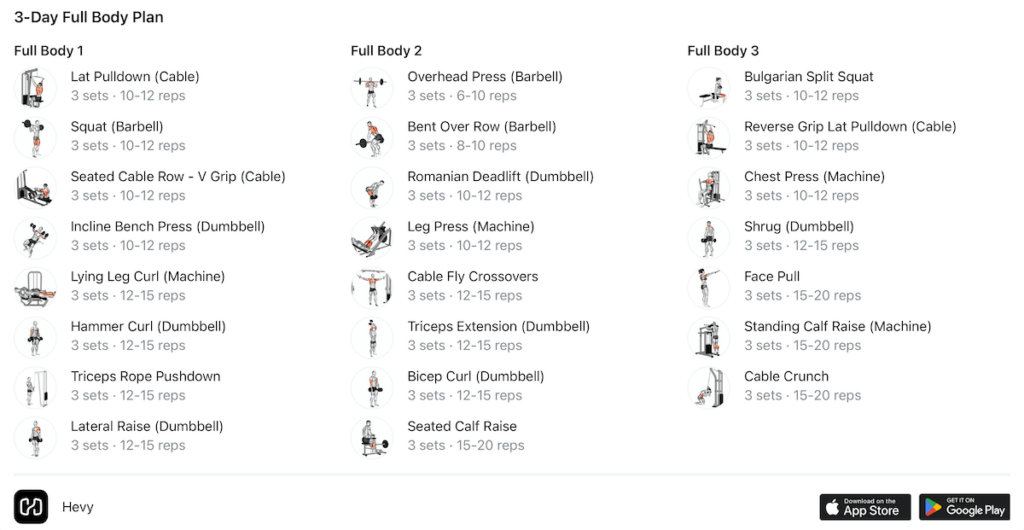
Doing a full-body workout 3 times a week involves working out every major body part in each session (upper and lower body).
Even though we’re training full body, the 3-day full body split will still consist of three different sessions. A weekly schedule for a full-body training plan could look like this:
Monday: Full Body 1
Tuesday: Rest day
Wednesday: Full Body 2
Thursday: Rest day
Friday: Full Body 3
Saturday: Rest day
Sunday: Rest day
Basically, like any other 3-day approach.
If you want to have only two workout routines instead of three, you could also alternate between the two routines and schedule them like the 3-day upper/lower split above:
Week 1: Full Body 1/Full Body 2/Full Body 1
Week 2: Full Body 2/Full Body 1/Full Body 2
Let’s take a look at a sample 3-day full-body plan:
Full Body 1
- Lat Pulldown (Cable) – 3 sets (10-12 reps)
- Squat (Barbell) – 3 sets (10-12 reps)
- Seated Cable Row – V Grip (Cable) – 3 sets (10-12 reps)
- Incline Bench Press (Dumbbell) – 3 sets (10-12 reps)
- Lying Leg Curl (Machine) – 3 sets (12-15 reps)
- Hammer Curl (Dumbbell) – 3 sets (12-15 reps)
- Triceps Rope Pushdown – 3 sets (12-15 reps)
- Lateral Raise (Dumbbell) – 3 sets (12-15 reps)
Full Body 2
- Overhead Press (Barbell) – 3 sets (6-10 reps)
- Bent Over Row (Barbell) – 3 sets (8-10 reps)
- Romanian Deadlift (Dumbbell) – 3 sets (10-12 reps)
- Leg Press (Machine) – 3 sets (10-12 reps)
- Cable Fly Crossovers – 3 sets (12-15 reps)
- Triceps Extension (Dumbbell) – 3 sets (12-15 reps)
- Bicep Curl (Dumbbell) – 3 sets (12-15 reps)
- Seated Calf Raise – 3 sets (15-20 reps)
Full Body 3
- Bulgarian Split Squat – 3 sets (10-12 reps per leg)
- Reverse Grip Lat Pulldown (Cable) – 3 sets (10-12 reps)
- Chest Press (Machine) – 3 sets (10-12 reps)
- Shrug (Dumbbell) – 3 sets (12-15 reps)
- Face Pull – 3 sets (15-20 reps)
- Standing Calf Raise (Machine) – 3 sets (15-20 reps)
- Cable Crunch – 3 sets (15-20 reps)
In this sample full-body workout plan, we include compound movements such as the bench press, bent-over row, and squat.
While not exactly a 3-day split, a 5×5 workout plan consists of five barbell compound movements and is also a great way to get results, particularly strength gains. (Learn about training for strength versus muscle growth here.)
One advantage of full-body workouts is improved muscle symmetry. We all know that friend with a huge chest and skinny legs because they skip leg day. Full-body workouts help prevent overcompensation in certain muscle groups. Instead of having a single big leg day that feels daunting just to think about, you can do one or two leg exercises in each workout and still get the necessary volume to grow.
3-Day Upper/Lower/Full Body
(Click here and tap the blue Save Folder button to save this split to your Hevy profile.)
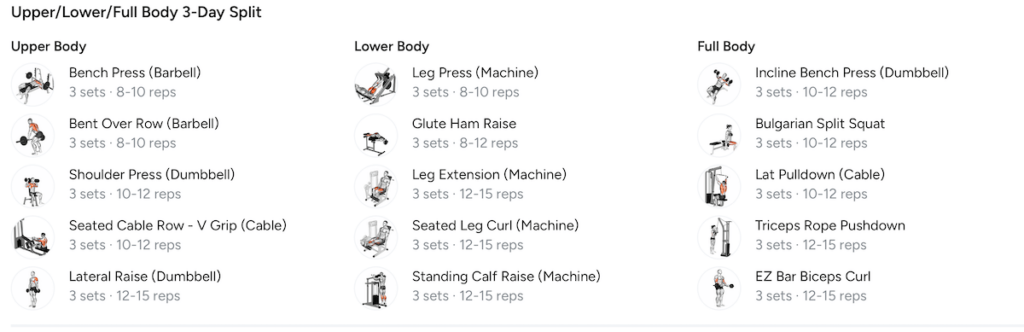
This plan consists of three unique workouts: upper, lower, and full-body. For instance:
Monday – Upper
Tuesday – Off
Wednesday – Lower
Thursday – Off
Friday – Full Body
Saturday & Sunday – Off
Here is a sample upper/lower/full body routine:
Day 1: Upper Body
- Bench Press (Barbell) – 3 sets, 8-10 reps
- Bent Over Row (Barbell) – 3 sets, 8-10 reps
- Shoulder Press (Dumbbell) – 3 sets, 10-12 reps
- Seated Cable Row – 3 sets, 10-12 reps
- Lateral Raise (Dumbbell) – 3 sets, 12-15 reps
Day 2: Lower Body
- Leg Press (Machine) – 3 sets, 8-10 reps
- Glute Ham Raise – 3 sets, 8-12 reps (weighted if necessary)
- Leg Extension (Machine) – 3 sets, 12-15 reps
- Seated Leg Curl (Machine) – 3 sets, 12-15 reps
- Standing Calf Raise (Machine) – 3 sets, 12-15 reps
Day 3: Full Body
- Incline Bench Press (Dumbbell) – 3 sets, 10-12 reps
- Bulgarian Split Squat – 3 sets, 10-12 reps (per leg)
- Lat Pulldown (Cable) – 3 sets, 10-12 reps
- Triceps Rope Pushdown – 3 sets, 12-15 reps
- EZ Bar Biceps Curl – 3 sets, 12-15 reps
Read more about it here.
These are just a few of the most popular 3-day split workouts. You can customize these workouts to the fullest extent and ensure you use the gym to your advantage for your goals.
Download the Hevy app and navigate to the library (Workout tab > Explore) if you want a full-body workout plan. We have nine options (along with 15+ other programs) for all levels.
What Equipment Do You Need For a 3-Day Split?
Gym
The equipment used in the above 3-day workout routines is pretty standard. You can do most exercises with a barbell and dumbbells, so a gym with basic equipment should be enough to effectively complete your workout routine.
Home Gym
When planning to create a home gym, you must consider a few essentials.
Dumbbells
Dumbbells can be an incredibly useful and flexible piece of equipment. You have two options:
- Get old-school fixed-weight dumbbells. You can also find these second-hand at a discount.
- Get more advanced adjustable dumbbells like the Bowflex SelectTech Adjustable Weights. If you’ve never used those, they are incredible.
Some advantages of adjustable dumbbells include:
- They take up less space because you have two dumbbells, weights, and weight trays.
- They are cheaper than buying a whole set of different weights.
- With their advanced mechanisms, you can quickly change the weights and even do supersets.
Some traditional dumbbells are also widely available, as seen below. These will also do the job, although they will take up more space. We recommend you check out these Rubber Hex Dumbbells.
Hevy’s program library offers 25+ programs, some dumbbell-only and some equipment-free.
An Adjustable Bench
Pairing dumbbells with an adjustable bench lets you do even more exercises, keeping your workouts varied and interesting. Some cool dumbbell + bench exercises include:
- Flat/Incline Dumbbell Press
- Seated Dumbbell Shoulder Press
- Arnold Press
- Seated Lateral and Front Raises
- Incline Bench Rear Delt Fly
- Incline Bench (Chest-Supported) Dumbbell Row
- Dumbbell Pullover
- Dumbbell Preacher Curl
- Seated Overhead Tricep Extension
- Bulgarian Split Squat
A basic flat bench would be cheaper, but having the option to adjust the angle of the back support gives you more training options.
Pull-Up Bar
A pull-up bar is another excellent tool to get for home training. The most practical option is a doorway pull-up bar since you don’t have to drill holes and whatnot.
You can also get a wall-mounted pull-up bar, which is generally sturdier. However, you may need to call a professional to install it. The third option is a dip stand with a pull-up bar, similar to a Captain’s chair.
A pull-up bar would allow you to do various effective bodyweight exercises, including pull-ups, chin-ups, hanging knee/leg raises, and L-sits.
Resistance Band Set
Similar to adjustable dumbbells, resistance bands are compact, affordable, and highly versatile. You can use them to do alternatives to popular gym exercises like bicep curls, tricep extensions, lateral raises, and lat pulldowns.
They are also useful for warm-ups since you can start with the lightest band that offers the least resistance and gradually work up to the toughest one as your muscles warm up.
Bands are also useful for modifying exercises and adjusting their difficulty. For instance, you can wrap a loop band behind your back and over your hands to make regular push-ups more challenging; alternatively, wrap the same band over your pull-up bar, step on it, and make pull-ups easier.
Other Equipment
As long as you have the budget and space, you can gradually expand your home gym with equipment like a squat rack, a barbell, an EZ bar, weight plates, and accessories such as a weight stand, kettlebells, an ab wheel, and even plyo boxes.
That said, the equipment discussed previously is enough for most people, so it comes down to priorities, preferences, and how much you’re willing to spend.
Is a 3-Day Split For Me?

I am looking to gain muscle
Muscle gain is straightforward. Go to the gym consistently, lift weights to stress your muscles and create micro-tears, and recover well. Gradually increase the difficulty of your training (don’t do the same thing repeatedly), and your muscles will grow.
We also can’t forget about nutrition, which is part of the recovery process. While it’s possible to gain muscle on fewer calories, optimal growth occurs when you eat more calories than you burn. This provides your body with the energy it needs to carry out its processes and build new muscle tissue. Research also recommends 1.6-2.2 grams of protein per kilogram, or roughly 0.7-1 gram per lb.
I want to get stronger
Most people who want to build muscle also generally want to get stronger, which means the training plan they follow must help them achieve both goals.
That said, while any 3-day split will bring some strength gains, especially for beginners, you may need a different approach. One option is a full-body 3-day program similar to the ones discussed above. Doing so would allow you to do the core lifts like squats and the bench press more often. This helps you build the necessary skills and movement proficiency and generally leads to quicker strength gains.
A daily undulated approach can work quite well. For example, you can bench press three times per week and do a different set and rep structure for each session, such as:
- Monday – 4 sets of 8-10 reps
- Wednesday – 4 sets of 6-8 reps
- Friday – 4 sets of 4-6 reps
The beginner 5×5 plan is also a great option that gets you to do the core barbell lifts more frequently and with heavy enough weights to optimize strength gain. So, there are ways to set up a 3-day resistance training split if you mainly care about improving your performance on barbell lifts.
I am looking to get leaner
Weight loss is not always about working out or doing a specific routine. The most important factor is creating and sustaining a calorie deficit – in other words, eating fewer calories than you burn. For instance, if you expend 3,000 calories daily but only eat 2,500 calories, that creates a 500-calorie deficit.
The best way to create and sustain a deficit is to be more disciplined with what you eat. This is because it’s easier not to eat 100 calories than to spend 10 minutes jogging to burn the same number of calories.
That said, losing weight is a bit different from getting leaner. Getting lean means losing body fat while maintaining as much muscle as possible. Doing so requires more attention to details like:
- Your workout routine
- Your protein intake
- Your recovery (nutrition, sleep, how you structure your training, and whether you do other physical activity)
Fine-tuning these things allows you to train hard enough to maintain muscle, diet effectively to see steady fat loss, and recover well so you’re not at risk of overtraining.
A 3-day split is fantastic if you’re looking to lose fat, as it allows you to get enough training volume to maintain muscle while burning calories without causing recovery issues. Remember that being in a calorie deficit affects recovery, so a more moderate approach could be better, even for more advanced trainees.
How to Program Warm-Up Sets in Your Split
Warm-up sets help prepare your body and central nervous system for heavy lifting, ensuring optimal performance and limiting the risk of injury. They also allow you to practice proper form with a lighter load and help you identify potential aches early.
The workout splits above all have routines with the recommended number of working sets. However, we suggest warming up properly for your workout, especially for the first exercise, and if you go heavy (70-75%+ of 1RM).
We recommend warming up with at least one or two light sets with little weight and working your way up. For example, if you’re warming up for squats, you could start with just the bar and gradually increase the weight until you reach your working weight.
Let’s say your working weight is 225 lbs. Your warm-up sets could look like this:
- Set 1 – 45 lbs x 10-20 reps
- Set 2 – 135 lbs x 3-5 reps
- Set 3 – 185 lbs x 1-2 reps
- Set 4 – 225 lbs (the first working set)
Don’t be too conservative with the weight increases, or you’ll end up doing too many warm-up sets. That could waste unnecessary energy and time and affect your overall training quality.
On that note, Hevy has warm-up sets you can customize and add to any exercise with a single tap. Learn about the feature here.
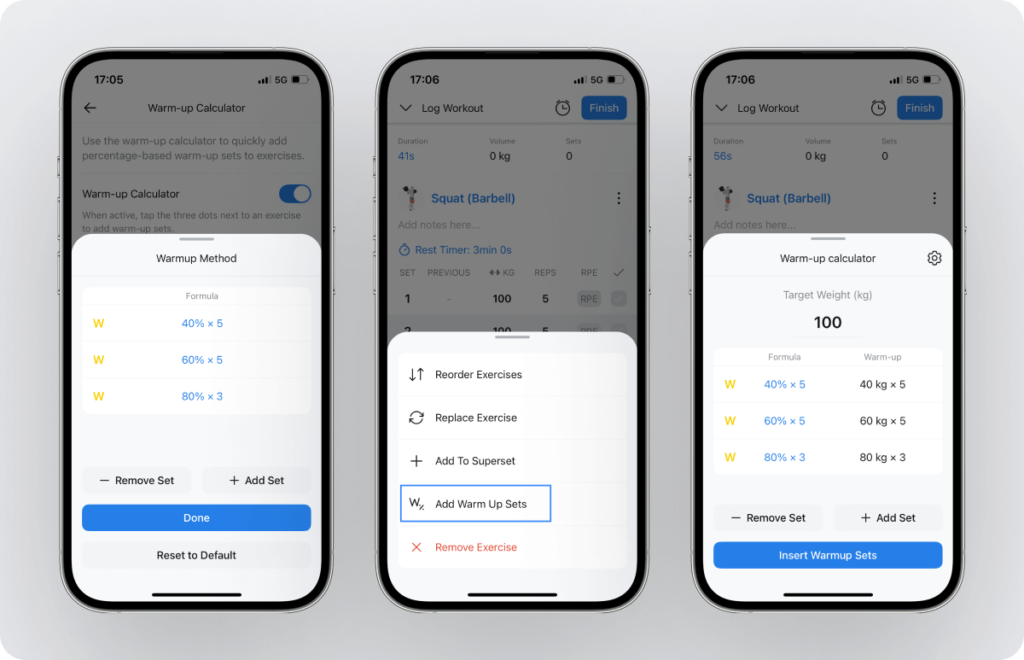
If your working weight is lower than a normal-sized barbell, you could take a couple of dumbbells to warm up.
Naturally, warming up will make your workouts a bit longer, but that’s okay. Think of it as an investment in your longevity, well-being, and optimal performance. Sure, you could save a few minutes by not warming up as diligently, but that can affect your performance and possibly lead to nagging aches.
Also, remember that your workouts start when you begin the warm-up, not when you start doing the working sets. Simply think of them as a necessary part of a safe and productive workout.
What Are The Benefits of Doing a 3-Day Split Workout?

The benefit of a 3-day split workout is that it works for most people. It will work for those who aren’t aiming to compete professionally in bodybuilding events and simply want to stay active and gain muscle. The 3-day workout split lets you work out your entire body and get proper rest. It is extremely effective for those who stick to it and are consistent.
Is it the best possible solution? Maybe not for everyone. But it works well enough and provides a perfect balance between time efficiency and results.
What is the Best App For a 3-Day Split?
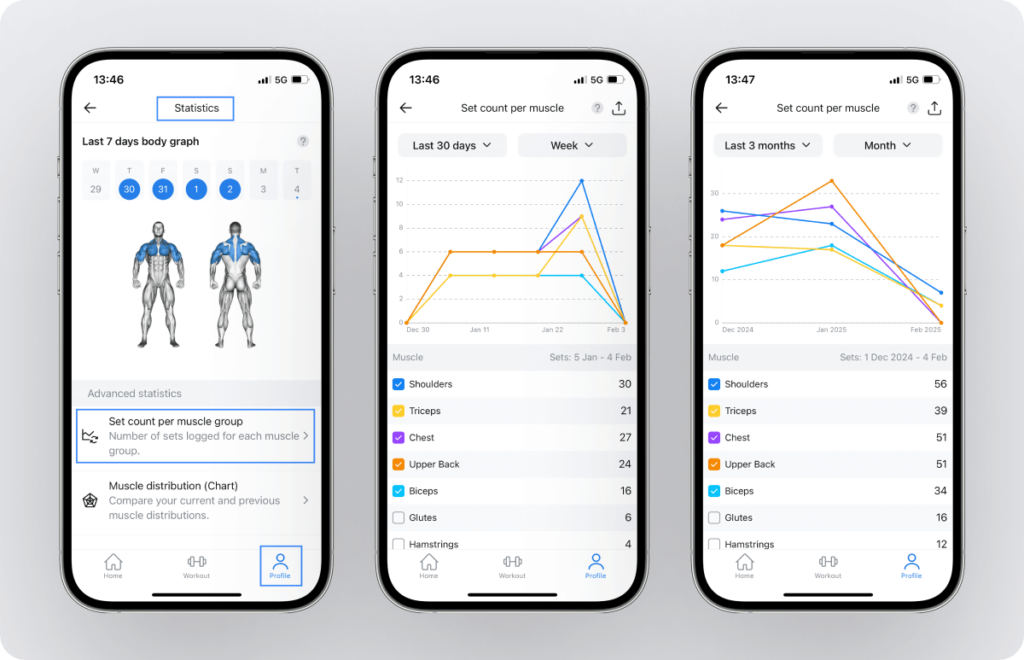
We recommend the Hevy workout tracker because it has built-in analytics to track your performance on each lift, see how many sets you do per muscle, and monitor how your training volume is distributed across body parts.
It also lets you compare your performance to other app users, see their workouts, and compete on the leaderboards. Just as a 3-day split brings results without a huge time commitment, the app you use should cover your needs without feeling like a burden.
Also, whether looking to build muscle or lose fat, monitoring your calorie intake and maintaining the necessary calorie surplus or deficit is essential. So, pick up a good nutrition tracker like Cronometer. The more control you have over variables essential to your training, like diet, consistency, and tracking in your training, the better results you will see in the short and long term.
3-Day Split vs. 5-Day Split
A 3-day split is a comfortable start for beginners to work out their whole body in 3 sessions, such as doing a full-body plan. In contrast, a 5-day split lets you give each area more attention through more direct exercises and sets – for example, by doing a bro split consisting of individual chest, back, legs, shoulders, and arms workouts.
Three weekly workouts are more manageable, easier to recover from, and ideal for busy people. This means you do each workout feeling fresher and more motivated, which allows you to push harder and may lead to better long-term progress. Five workouts require more time, are harder to stick to, and increase the recovery demand. If you can’t recover well, you’ll struggle to keep up, and you might lose the motivation to train.
Plus, a 3-day plan is better when losing fat (in a calorie deficit) since your recovery will be impaired to some degree. A 5-day split would be better for when you have more free time, can recover well, and are in a small calorie surplus to build muscle.
Bodybuilders often go for 5- or even 6-day splits to get more opportunities to do different exercises and hit each muscle more frequently. However, as discussed above, the average person can achieve almost optimal results with a lower frequency.
How Long Should I Follow a 3-Day Split to See Results?
We recommend following a 3-day split (or any plan, for that matter) for at least eight weeks to start seeing improvements before making any changes to your approach. Jumping from program to program and constantly trying to optimize things is more likely to keep you stuck.
This is because your body needs time to adapt to a certain amount and type of physical stress. Plus, sticking to the same training plan allows you to track your performance more effectively and see if you’re moving in the right direction.
It’s much easier to compare your week-to-week performance on the same exercise than to figure out if you’re doing better when it’s a new exercise each week.
Plus, if you’re a beginner or someone returning to the gym after a long layoff, your body will be more responsive, and any training will feel like a shock to the system. As such, you’re likely to see better growth and strength gain (so long as you also eat well and recover between workouts) even with three weekly sessions.
The ‘shock’ provided by your training will gradually decrease the longer you go to the gym, and gaining muscle will become more challenging. The same is true for someone who is overweight.
Someone who is overweight and doesn’t do any exercise will see significant changes in their physique and strength once they start going to the gym. However, as the pounds keep shedding off, the weight loss momentum will decrease as the body gets used to the level of movement and strenuous exercise.
At that point, it would make sense to re-evaluate your nutritional targets and workout plan to see what changes you can make to improve the whole process.
Should I Be Taking Supplements for My 3-Day Split?
The question of supplements is often tied to an athlete’s diet, or at least that’s how it should be. How much protein is the athlete consuming? Are they in a caloric surplus? Are they looking to gain or lose weight? There are several variables to consider before buying protein powder, creatine, a pre-workout, or another supplement.
For people starting a gym routine and looking to gain muscle and strength, we always recommend prioritizing their diet first. Are you eating enough? Is your diet already naturally rich in protein? Ask those questions first.
If you have trouble eating enough calories to be in a caloric surplus, switching to drinking your calories can always be beneficial. That means adding something like a mass gainer or a protein shake to your meals for extra calories.
Here are some supplements to consider if you’ve taken care of your diet and eat enough protein and calories for your goals:
Pre-workout
A pre-workout supplement is meant to give you an extra boost during a workout. For example, going to the gym after a long day of work or first thing in the morning can be challenging. Getting extra energy from a supplement can help you push harder, stay more focused, and provide the necessary stimulus to grow and get stronger.
Commercial pre-workout can include ingredients like:
- Caffeine
- Beta-alanine
- Citrulline malate
- Creatine (which we’ll talk about in a bit)
- Branched-chain amino acids (BCAAs)
- Betaine
- Sodium bicarbonate
Some people also buy raw ingredients and mix them into effective pre-workouts at a lower cost. Good pre-workout ingredients you can buy separately and mix into a formula include beta-alanine, citrulline malate, and creatine. Omar Isuf has an excellent video demonstrating how to make your pre-workout.
Pre-workouts without stimulants, also known as stim-free pre-workouts, lack caffeine and instead rely on other common ingredients for the performance boost. Such a pre-workout might be a good option if you train in the evening. The reason is that having caffeine as part of a pre-workout can interfere with your sleep.
Protein Powder
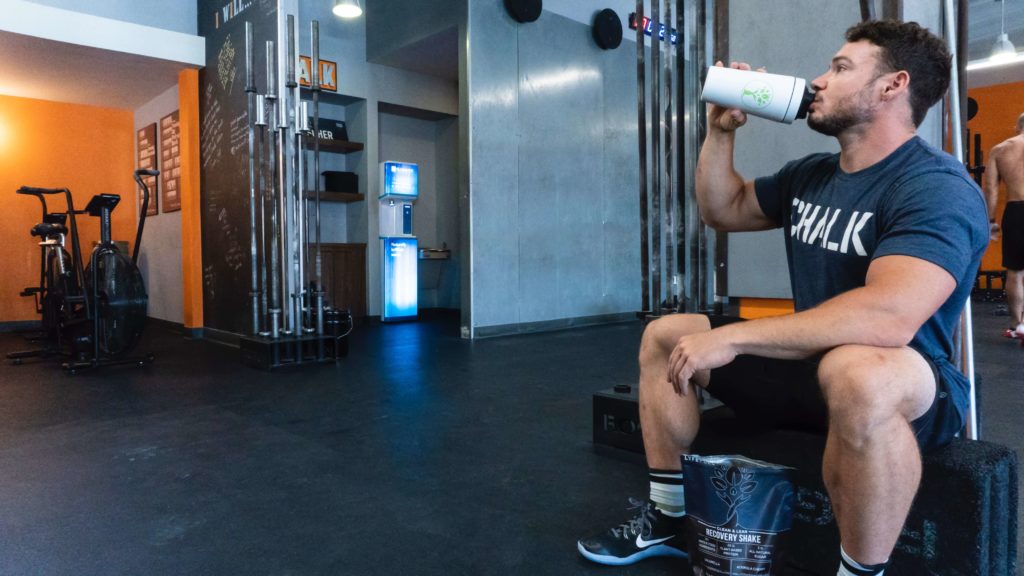
Protein powder is not mandatory for muscle growth, but it can be a nice way to supplement your diet and ensure you get the recommended 1.6-2.2 grams of protein per kilogram (or 0.7-1 gram per lb).
Having a steak for breakfast or a salmon filet isn’t always practical or appetizing. So, having a simple protein shake and adding other tasty ingredients like fruits and oats for extra calories, and milk for fat, will be an easy way to add calories to your diet.
The type of protein powder you get is also up to you. Whey protein is the go-to option for many, and you can largely pick between concentrate and isolate.
Concentrate is the slightly less refined option with around 80% protein content––a 30-gram scoop would provide roughly 24 grams of pure protein. Isolate is the more refined but also more expensive product with up to 90% protein, or roughly 27 grams per scoop.
Casein protein is also a good option, particularly before bed, as it digests more slowly and provides a steady release of amino acids to support muscle recovery after a long day. That said, not everyone tolerates dairy protein well. Beef and egg powders are good alternatives that provide high-quality animal protein.
Vegans can consider plant-based proteins or blends, such as hemp with pea and pumpkin seeds. Remember that plant protein is sometimes incomplete (lacking one or more of the nine essential amino acids your body needs) and may not provide the same growth stimulus as animal protein.
Creatine
Creatine is an organic compound formed from three amino acids: L-arginine, glycine, and L-methionine. It is naturally found in muscle cells, with trace amounts in the brain and other organs. Your body naturally produces creatine, but supplementing with three to five grams daily can help improve performance, gym recovery, and even muscle growth.
This is because creatine helps your body produce ATP (adenosine triphosphate) molecules – the primary energy currency for your cells and muscles. “High-intensity exercise can result in up to a 1,000-fold increase in the rate of ATP demand compared to that at rest.” (Baker et al., 2010)
By donating a phosphate group, creatine can help boost ATP production, which has been shown to increase time to exhaustion, improve performance, and positively impact long-term gym results. From a purely aesthetic standpoint, creatine can also help your muscles look slightly fuller because it helps intramuscular water retention. (This is not the same as subcutaneous (under the skin) water retention, which can make you look puffy.)
For this reason, it is recommended to increase your daily water intake if you take creatine supplements. A good target is up to 3.7 liters for men and up to 2.7 liters for women.
Always consult with a medical professional before taking a supplement like creatine, as these products aren’t as strictly controlled by the FDA.
FAQs
What is a 3-day split workout?
A 3-day split is one where you do three weekly workouts, typically targeting a specific area in each session. The goal is to cover all body parts, train each muscle enough, and recover well before the next session. One of the most popular 3-day splits is push/pull/legs, where you do workouts based on movement types: push (chest, shoulders, and triceps), pull (back and biceps), and legs (quadriceps, hamstrings, glutes, and calves).
How much rest should I get for growth?
Recovery is strongly individual and depends on your experience level, genetics, nutrition, stress outside the gym, and the amount of training you do in each session. As such, you should determine how much recovery you need by considering post-workout soreness, your daily energy levels, and the quality of your sleep.
For example, someone starting a 3-day split workout will have a hard time returning to the gym the day after training. That person might take between two and four days off to rest between sessions. As a beginner, aim for 48 hours of recovery between workouts. For instance, if you work out on Monday, train on Wednesday, and then on Friday.
We have plenty of athletes on our app who work out 6 or more times a week, but it takes years of consistent training to get to that point.
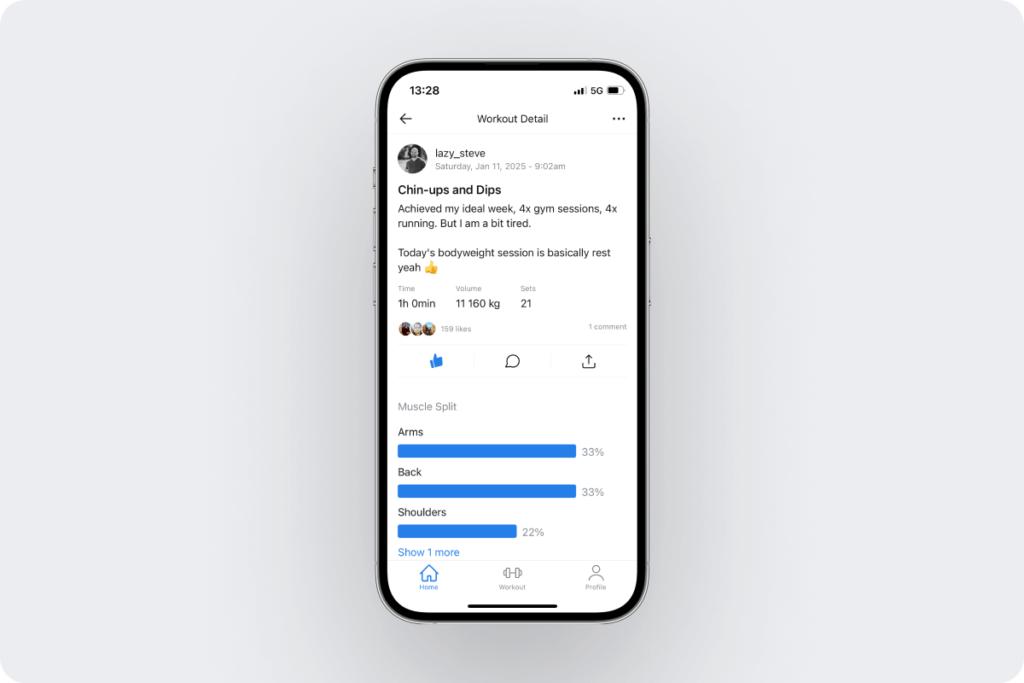
Should I do a 3-day workout split as a beginner?
Yes, a 3-day split is a great starting point for beginners, especially those busy with work, school, family, or other obligations. Learn about full body vs split training and why the former might be better for you in this case.
Training three times per week might not seem like much, but it’s much better to be consistent with that than to dedicate yourself to a high-frequency split and constantly miss workouts because you’re too tired, unmotivated, or don’t have enough time. Develop a routine, stay consistent, and aim for small and steady improvements. The results will come.
Should I do cardio on a 3-day split?
Most splits don’t list cardio as essential unless they target hybrid athletes. However, that doesn’t mean you should never do it. Cardio can be a great way to warm up before training and could also be a nice way to promote active recovery on your days off from the gym.
Plus, it helps boost work capacity, allowing you to handle, recover from, and adapt to more training in the future.

That said, cardio can also be demanding, so be careful of the amount, type, and intensity. For instance, interval running would be more taxing than leisurely cycling. As a rule, start with less cardio and at a lower intensity to see how it affects your recovery, especially around leg workouts.
How is a 3-day split different from a “bro split”?
A 3-day split can be a bro split, but it can also be a push/pull/legs, full-body program, or even an upper/lower split (on a two-week rotation, as discussed above). There isn’t a big difference; it’s mostly just a tool to organize your training.
For example, a 3-day bro split could be essentially the same as a push/pull/legs 3-day split; it’s just a different name with perhaps a slightly different approach to organizing the workouts.
That said, a bro split can also be a 4-, 5-, or even a 6-day split. For instance, here is a 5-day bro split:
Monday – Chest
Tuesday – Back
Wednesday – Legs
Thursday – Shoulders
Friday – Arms
Is working out 3 days a week enough?
It depends on your effort, goals, and the time you have available to train. As discussed above, a 3-day split balances time efficiency and results, making it an attractive option for beginners and everyday people who can’t make it to the gym often.
Plus, beginners typically don’t need to train more than three times per week. That’s enough to provide a good stimulus and grow without feeling overwhelmed or overtrained.
More advanced trainees can also train three times a week, but each session might need to be longer to do enough exercises and sets for optimal growth. Alternatively, trainees can add a fourth, fifth, or even sixth workout if they don’t feel like a 3-day split challenges them enough.
Can I do a bodyweight 3-day split?
There are plenty of equipment-free and bodyweight alternatives to traditional gym exercises, so why not start with those if you’re new or unable to get to the gym regularly? For example, you can substitute the bench press with push-ups or barbell squats with a simple bodyweight squat, and easily incorporate pull-ups or ring rows into your back workouts.
Starting with bodyweight exercises to gain proper strength is always recommended before adding weight to build muscle. You will struggle to bench significant weight if you cannot do ten bodyweight push-ups in a row.
The same goes for weighted squats. Developing proper squat technique with good mobility is essential for gym-goers. When you’ve already developed enough strength for bodyweight squats, try doing goblet squats to prepare for barbell squats.
In Hevy’s routine library, you can set the equipment filter (Workout tab > Explore > filters at the top) to None to access plans that can be done without equipment, even at home.
What are the main 3-day split exercises?
It’s hard to answer this question, as it depends on your preferences, goals, available equipment, and anatomical limitations. For the average gym goer who is trying to gain strength and muscle on а 3-day split, the following would be good exercises:
The barbell and dumbbell bench press are proper and effective exercises for targeting the chest, shoulders, and triceps during push workouts. Both movements have a good overloading potential and help develop strength for other upper-body lifts.
The pull-up is an excellent compound bodyweight exercise that targets the back and biceps during pull workouts. Being good at pull-ups and comfortably doing sets of 10-12 reps will mean you can perform quite well in other back exercises.
Pull-ups also offer good progression, as you can work up to 10-12+ reps per set and transition to weighted pull-ups and chin-ups, where you typically use a weight belt to attach plates to yourself for additional resistance.
For more complete back development (particularly developing the lower back), you could also consider deadlifts. As always, proper form is key for optimal growth and safety.
Barbell squats are the go-to choice for an effective leg workout. Focus on proper mobility and depth, aiming to get your thighs to parallel or slightly lower. This means your hips reach knee level or slightly lower on each rep. Doing so helps maximize quadriceps loading and leads to better glute activation.
Once you reach a point where bodyweight squats feel too easy, start with an empty barbell weighing 20 kilograms (45 pounds). Then, gradually add weight as you build strength and get more confident with a weight on your back.
Should I be worried about overtraining with a 3-day split workout?
Overtraining is a common concern, especially for newbies who experience intense delayed-onset muscle soreness (DOMS) following their first few gym sessions. But the reality is, there’s a small risk of overtraining at this moderate frequency, unless each workout is super long (well over 20 working sets) and you push each set to failure.
Of course, there is a point where someone might do too much and struggle to recover between workouts, so it’s important to gauge your recovery and how you feel outside the gym. If you’re constantly sore, weak, and feeling rundown, you might need to scale back your training and gradually build your capacity.
You shouldn’t be in a situation where you have to train while you’re extremely sore or tired that your warm-up sets feel like working sets. Aside from impacting progress, this can affect your technique and cause you to use compensatory movement patterns, such as excessively rounding your back during deadlifts, to do your programmed sets and reps.
What is the best warm-up for a 3-day split?
Warm-ups for any type of split or workout at the gym should be conscientious of the movements you are about to do. A full-body dynamic warm-up is generally best, but what you do beyond that should depend on the workout’s focus. For example, if you’re about to do a leg day, you should spend more time warming up your lower back, hips, knees, and ankles.
Similarly, if you’re about to do a push workout, spend more time on your upper back, shoulders, neck, elbows, and wrists.
Once that’s done, you can do warm-up sets for your first exercise of the workout to further prepare your body for that specific activity. We discussed warm-up sets above, but the gist is to gradually increase the weight over two to four sets until you reach your working weight.
For example, if you’ll be squatting 225 lbs, you could lift 45 lbs on the first set, 135 lbs on the second set, 185 lbs on the third set, and then start your working sets with 225 lbs.
The Hevy app has a warm-up set calculator you can configure. Once you choose a structure (you can also stick with our default recommendations), you can easily add multiple warm-up sets to any exercise with a single tap. Learn about the feature here.
How long should my workouts be in a 3-day split workout?
Like other things, this is somewhat individual and will largely depend on your available time to train and your experience level. For example, more experienced trainees might need to train for longer (say, 75+ minutes) to complete enough exercises and sets to create the necessary disruption for growth. In contrast, a beginner may only need 45 minutes.
That said, keep in mind that there’s no strict time limit. Some workouts may be shorter or longer, depending on how well you recover between sets, how easily you can access different machines at the gym, and how quickly you complete individual reps.
The most important thing is to leave the gym feeling tired and accomplished, but not completely exhausted.
Can I do other exercises on my rest days (like playing sports)?

Your typical 3-day split won’t be that challenging, but you may want to limit other activities, at least for the first few weeks. Doing so is important to gauge the overall difficulty and how well you recover between workouts. After that, you can introduce other activities, such as sports and cardio, but avoid exercises that are too strenuous and may affect your performance at the gym.
Consider the timing, as well. For example, avoid intense cardio activities like pick-up football games before difficult workouts, such as leg day.
Also, consider activities outside the gym when deciding how many calories to eat. If you burn many calories through sports like basketball or weekend activities like hiking, maybe increase your calorie intake to a degree, regardless of whether you’re trying to lose fat or gain muscle.
In both cases, eating too few calories can affect your results, so be careful and monitor your body weight to stay on the right track.
Finally, take an extra day or two to recover if you need it. Remember that you are building a lifestyle, and you shouldn’t feel forced to exercise every day. Flexibility can go a long way in keeping you motivated and consistent in the long run.
How many sets should I do per muscle group?
You’ll likely come across many recommendations, ranging from 5 to 6 sets per muscle per week to 20+ sets. Yes, more sets generally lead to better growth, but there is a point of diminishing returns where each additional set brings less and less value. You can read more on the topic in our guide on sets per muscle.
We recommend aiming for something in the middle:
- For larger muscle groups, such as your chest, back, and quads, aim for 8 to 15 sets. Do different variations and exercises to hit your muscles from multiple angles.
- Smaller muscle groups, such as the biceps, triceps, shoulders, calves, and hamstrings, can grow well with as few as 5 to 10 weekly sets.
Once again, it depends on your goals, preferences, and training availability. You can always increase or decrease your volume depending on how much you’re willing to endure and whether a certain volume leads to the desired progress.
Speaking of sets per muscle, the Hevy app allows you to track and display that data on a customizable graph. Log your exercises, and the app will calculate everything for you. See your training volume for each muscle to know if you’re within the optimal range.
A final note.
We want everyone to be healthy and active. Any type of movement will benefit your body, health, and well-being. Going to the gym is just one way to stay active, and we hope this complete 3-day split guide serves as a good introduction to the theory and understanding of what it takes to be successful at the gym, depending on your goals.
These are the top 5 ideas that we think summarize this complete guide of 3-day lifting for everybody who goes to the gym:
- Start slow, and make sure your form is correct. Don’t go to the gym expecting to lift the same as everybody else. Especially don’t feel ashamed about starting with less weight than everybody else, everyone was there at some point or another.
- Be consistent. Consistency is the name of the game, and significant results won’t be seen without it. Track your routines and make sure that you see results over time to stay motivated. Get on Hevy for easy workout logging, in-depth analytics, and socializing with others.
- Take care of all of the variables outside the gym. That includes diet and recovery. Take care of your body and listen to it. Be responsible with your warm-ups and consider cool-down stretches. Your body will thank you when you’re older.
- Bring intensity to your workout. You won’t see proper results without consistency, and more importantly, if you’re inconsistent with your intensity. Make sure you’re leaving the gym feeling content with your intensity as you work towards your goals.
- Set realistic goals. Be honest about how much your body can take and how much you can push it. Don’t lift with your ego. Lift to train the correct muscles, become a better athlete, and be in better shape.
We hope this 3-day split guide has been informative and motivational for you, and that you’ll soon head to the gym with more confidence than ever. As always, don’t forget to download our app. We wish you the best of luck with your 3-day split workout routine.
Hevy has a rich library with multiple 3-day splits for all levels. To access them, open the app, go to the Workout tab, and tap Explore. The programs and routines are free for everyone.
If you want to learn how we built our app, check out this post.
We’ll see you on Hevy.




7 thoughts on “3 Day Split Workout – The Complete Guide (2026)”
Thanks for the wonderful guide! I am relatively new to the gym and was thinking whether or not I should start a 3 day guide or a 5 day guide. This helped me decide. I’ll download the hey app hopefully it helps.
This is EXACTLY what I was looking for, THANK YOU!! You made this gal EXTREMELY happy! Installing Hevy app right NOW! 😃
Couldnt of asked for something more perfect.
The workout plan
The App to track
and all the info needed to decide what I need to choose and why
PERFECT!! Thank you so much!
I am interested in starting the UPPER/LOWER split BUT, I am worried that there aren’t enough exercises for each muscle group in this scenario. Am I missing something in my assumption?
Thanks for sharing this. Keep it up
I have been following the Classic 3 day Bodybuilder Split routine for 6 weeks now. What plan would you recommend after I’ve done this for 8 weeks?
On the 3-day upper/lower split, would it be OK to add Stiff-Legged Deadlifts on the Lower day?
Thanks.