
What is a 2-day Split?
A 2-day split is a training schedule where you perform two weekly workouts. The most common split options are full-body and upper/lower. A full-body workout split means performing two sessions in which you train all major muscle groups. In comparison, a 2-day upper/lower split means doing one lower-body and one upper-body workout each week.
You can also do a 2-day push/pull/legs program, alternating weekly. For example, you do push and pull one week, then legs and push the next. The downside is the lower training frequency, since you’d train each major muscle group twice every three weeks.
Training only twice per week might seem insufficient, but many lifters can make decent progress if they do enough work in each workout, push themselves hard, and aim for steady progress (1).
The 2-day split is suitable for beginners because it isn’t challenging to sustain and doesn’t feel overwhelming. But having two weekly sessions is more than enough to cause an adequate stimulus for muscle growth and strength gain.
Key Takeaways
- The two best ways to organize a 2-day split are: do two full-body workouts (training each major muscle group in each session) or train the upper body in one workout, and the lower body in the other.
- A 2-day split is a great way to get started with training since it’s easier to stay consistent and works well if you’re busy and can’t work out more often.
- A 2-day split is also good for athletes who practice activities and sports outside of the gym. It delivers strength training benefits without affecting recovery or performance as a high-frequency split would.
- With only two weekly workouts, you can push much harder than usual, taking most sets close to failure and doing more exercises, without worrying about overtraining.
- A 2-day split is a lower-volume one, which means progress occurs more slowly and may not be enough for more advanced trainees to see noticeable strength or muscle gains.
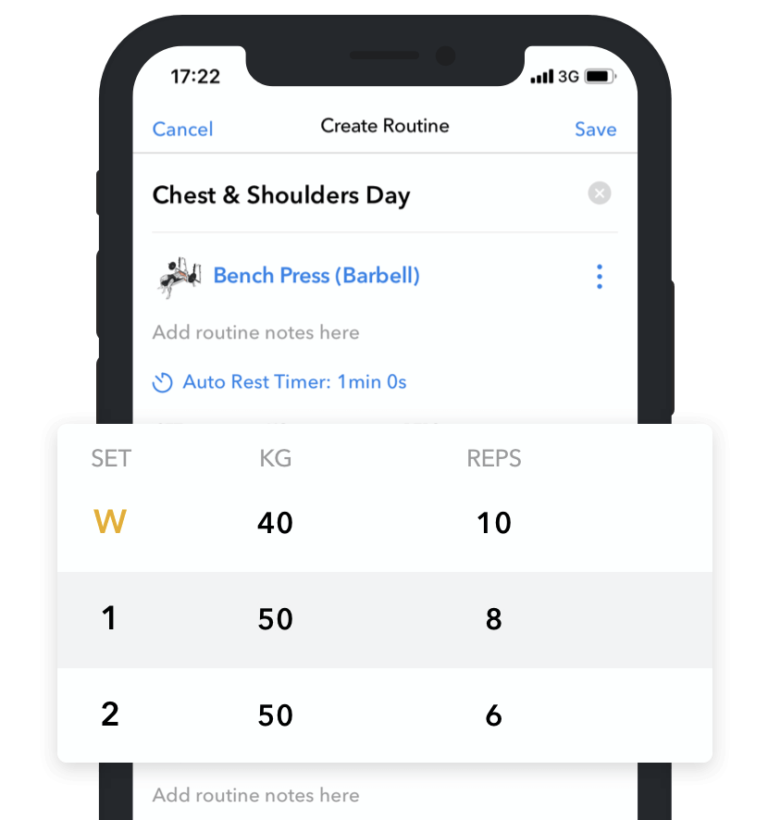
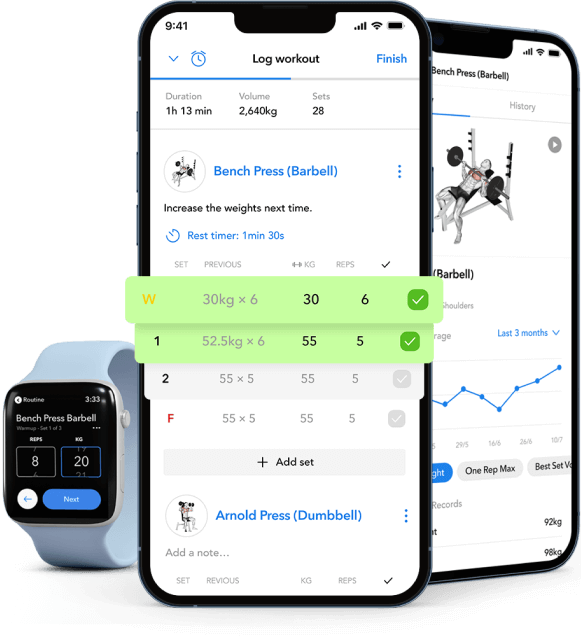
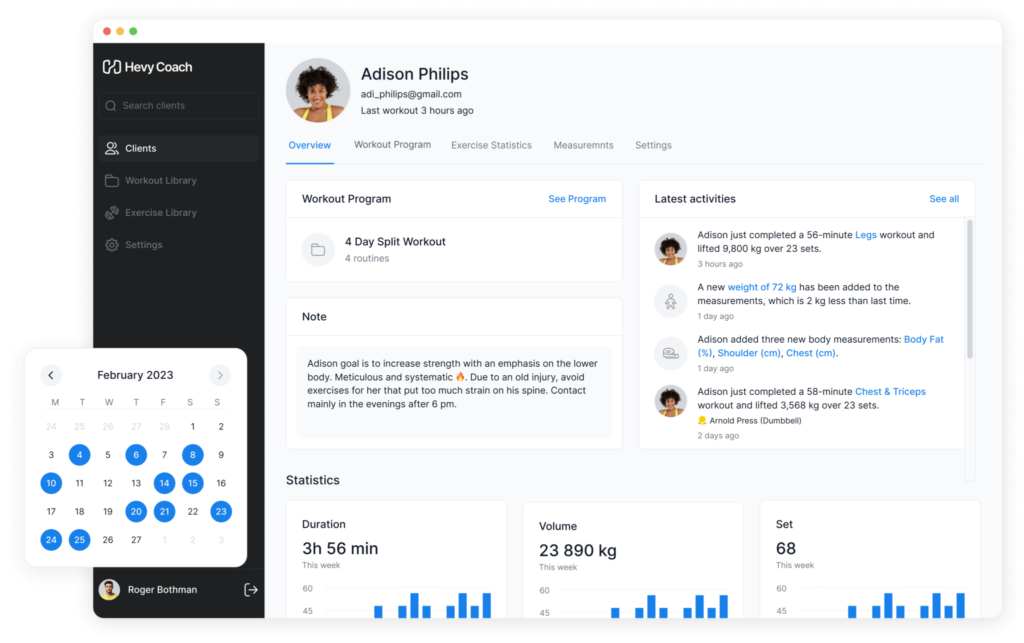
- Use Hevy to store your 2-day split, make modifications to your routines, log each workout in detail (sets, reps, weight, RPE, custom notes, and more), and track your training progress and body composition.
Who is a 2-Day Split For?
Beginners, busy people, and those looking to get some strength training benefits without spending too much time at the gym (for example, athletes who already spend a lot of time and energy on sports-specific training) can benefit greatly from a 2-day split.
First, beginners. Committing to a couple of weekly workouts isn’t difficult, and gym newbies won’t feel overwhelmed. They are more likely to enjoy their training, remain consistent, and make better progress.
Busy individuals can also benefit from a 2-day approach. Not everyone has an hour of free time or the ability to follow a 5-day split. For example, you probably won’t have much time to train daily if you’ve had a baby. A 2-day program can keep the momentum going, allowing you to make steady progress until your schedule frees up.
Or maybe you travel often. In that case, you won’t always be able to find a decent gym to keep up a high-frequency training approach. As such, committing to two workouts could provide enough structure and keep training on your mind.
As Chris Adams, a personal trainer, wrote: “One of the most frustrating things about being a personal trainer is seeing people throw away all their hard work by stopping training completely, or by taking large breaks when life is busy. They end up just working to regain what they had achieved before. I would rather they trained twice a week when life is busy than stop.”
People serious about improving in a specific sport or discipline can also benefit tremendously from a 2-day program. For example, endurance athletes looking to improve their fitness base and performance could perform two full-body workouts to build muscle and get stronger.
Similarly, athletes who practice a specific sport like football, basketball, or volleyball can also benefit from two weekly workouts.
A couple of weekly sessions won’t be too demanding to recover from, and they won’t get in the way of training and competing in their sport. But, as with endurance athletes, building strength and muscle can elevate their performance, making them more competitive.

Alternatively, you might find yourself traveling more for work or pleasure. In that case, you won’t always be able to find a decent gym to keep up a high-frequency training approach. As such, committing to two workouts could provide enough structure and keep training on your mind.
What is the Best 2-Day Split Workout Routine?
Full-body training is the right choice for most people because you can train all major muscle groups the recommended two times per week (2). Doing so promotes muscle growth and quicker strength gains, leading to superior long-term progress (3).
An upper/lower split is also a good option. One workout focuses on the upper body, and the other is about training your glutes, hamstrings, quadriceps, and calves.
This approach makes it easier to focus on fewer muscle groups and train each in a fresher and more recovered state. The only downside is that you’re only training each muscle group once per week.
People who do a lot of leg training outside the gym can leverage a push/pull/legs split. Instead of doing all three workouts, do one push and one pull session. Doing so would help you develop your upper body without causing excessive leg fatigue that can get in the way of activities outside the gym. Record your 2-day split: push/pull routine with Hevy and track your progress (learn why you should track your workouts).


Pros and Cons of the 2-Day Split
Pros
- There are several ways to program your training, including full-body and upper/lower
- Having only two workouts per week means you enjoy great scheduling flexibility and can switch around your training days based on your availability
- Having two full-body workouts per week is enough for most people to make decent strength and muscle gains, so long as they work hard and make steady performance improvements (4)
- A 2-day upper/lower split is also a fantastic option for people because it allows you to focus on fewer muscle groups and do enough productive sets for growth
- Having two weekly workouts works great for busy individuals because they can still make progress and keep the momentum going without living at the gym
- Twice weekly training works perfectly for athletes and competitors because it leads to progress and makes them more competitive without interfering with their recovery
Cons
- Two weekly workouts might not be enough for more advanced trainees to build strength and gain muscle
- A 2-day upper/lower split doesn’t allow you to train all muscle groups the recommended two times per week (2)
- Full-body workouts tend to be longer and more challenging to recover from, especially if you’re only doing two per week and need more sets and exercises
- Following a 2-day upper/lower split would mean that your upper-body workouts would have to be much longer and more demanding, simply because you must train more muscle groups
- You have limited time to practice the various movements in your training, making it more challenging to develop neuromuscular efficiency and continuously improve your technique
Types of 2-Day Workout Splits
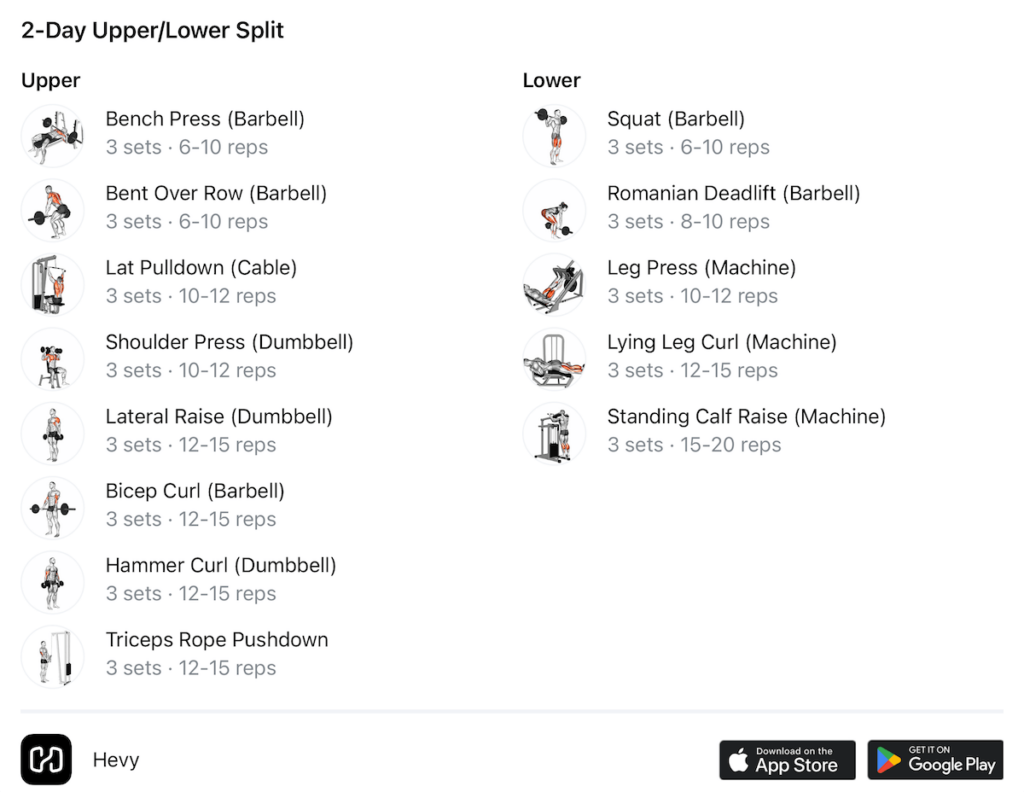
2-Day Upper/Lower Split
An upper/lower program is one where you split your training into two workouts:
- Upper, where you train all major muscle groups in your upper body (chest, shoulders, triceps, back, biceps, forearms, and midsection)
- Lower, where you train the glutes, hamstrings, quadriceps, calves, adductors, and abductors
The approach works well in a 2-day split, with one workout focusing on the upper body and another on the lower body.
Level: Beginner/early intermediate
| Day 1: Upper | Day 2: Lower |
| Bench Press (Barbell) – 3 sets (6-10 reps) Bent Over Row (Barbell) – 3 sets (6-10 reps) Lat Pulldown (Cable) – 3 sets (10-12 reps) Shoulder Press (Dumbbell) – 3 sets (10-12 reps) Lateral Raise (Dumbbell) – 3 sets (12-15 reps) Bicep Curl (Barbell) – 3 sets (12-15 reps) Hammer Curl (Dumbbell) – 3 sets (12-15 reps) Triceps Rope Pushdown – 3 sets (12-15 reps) | Squat (Barbell) – 3 sets (6-10 reps) Romanian Deadlift (Barbell) – 3 sets (8-10 reps) Leg Press (Machine) – 3 sets (10-12 reps) Lying Leg Curl (Machine) – 3 sets (12-15 reps) Standing Calf Raise (Machine) – 3 sets (15-20 reps) |
The Hevy app routine library has a beginner 2-day upper/lower split you can do with dumbbells. To access it, download the app, tap the Workout tab, go to Explore, and select Beginner in the Level filter and Dumbbells in the Equipment filter.

Modifications
You can modify your weekly training schedule, pick what exercises to do in each workout, adjust the number of sets, and pick the weight, which will influence the number of reps you can do.
First, the weekly schedule. You can train on Monday and Thursday, giving you plenty of recovery time. But if that doesn’t work, you can do:
- Monday-Wednesday
- Tuesday-Thursday
- Wednesday-Friday
- Monday-Friday
Or even two days in a row (not ideal, but can still work):
- Monday-Tuesday
- Tuesday-Wednesday
- Wednesday-Thursday
- So on.
Second, pick exercises you like, can do pain-free, and have the equipment for. The sample split calls for a barbell bench press, but you can swap it for a dumbbell press if you don’t have a bar.
Lastly, adjust the number of sets per exercise based on your recovery and available time. Similarly, pick weights based on your preferred intensity range. For example, if you want to go heavy on compound lifts, use more weight and do 4-8 reps per set. In contrast, if you prefer to go lighter, do 8+ reps per set on compound lifts (like the bench press) and 12+ on isolation lifts (like the bicep curl).
Schedule
Monday – Upper
Tuesday – Off
Wednesday – Off
Thursday – Lower
Friday – Off
Saturday – Off
Sunday – Off
2-Day Push/Pull Split
The push/pull split benefits people who train their lower body with activities outside the gym. As such, they don’t need gym training to develop their legs. This split is also good because it promotes muscle and strength gains without impairing recovery or fatiguing the lower body.
Level: Beginner/intermediate
| Day 1: Push | Day 2: Pull |
| Bench Press (Barbell) – 3 sets (6-10 reps) Incline Bench Press (Dumbbell) – 3 sets (8-12 reps) Shoulder Press (Dumbbell) – 3 sets (10-12 reps) Cable Crossover Fly – 3 sets (12-15 reps) Lateral Raise (Dumbbell) – 3 sets (12-15 reps) Triceps Rope Pushdown – 3 sets (12-15 reps) | Bent Over Row (Barbell) – 3 sets (6-10 reps) Lat Pulldown (Cable) – 3 sets (8-12 reps) Seated Cable Row – V Grip (Cable) – 3 sets (10-12 reps) Shrug (Dumbbell) – 3 sets (10-12 reps) Bicep Curl (Barbell) – 3 sets (12-15 reps) Hammer Curl (Dumbbell) – 3 sets (12-15 reps) Face Pull – 3 sets (15-20 reps) |
Modifications
You can modify the push/pull split by adding a leg day and alternating between the three workouts every three weeks:
- Week 1 – Push and pull
- Week 2 – Legs and push
- Week 3 – Pull and legs
- Week 4 – start over
Alternating like that lets you do a push/pull/legs split while only training twice a week. A notable drawback is that you train your muscles twice every three weeks, which makes it harder to build muscle and get strong.
Like the upper/lower split, you can also pick different exercises, experiment with more or less training volume, and vary the intensity. Doing so keeps your training engaging and helps you understand what works better for you.
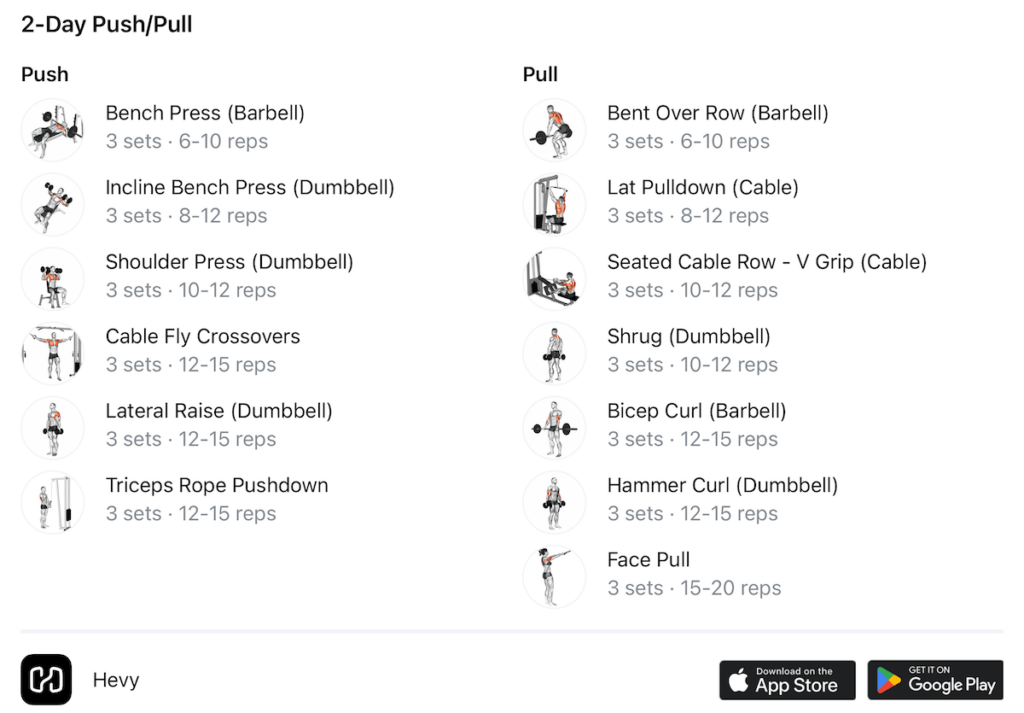
(Click here and tap the blue Save Folder button to save this split to your Hevy profile.)
Schedule
Monday – Off
Tuesday – Push
Wednesday – Off
Thursday – Pull
Friday – Off
Saturday – Off
Sunday – Off
2-Day Full Body Workout Split
A full-body approach is the most practical option for people who can only train twice weekly. As its name suggests, a full-body program is one in which you train all major muscle groups in each session.
Level: Beginner/intermediate/advanced
| Day 1: Full Body | Day 2: Full Body |
| Lat Pulldown (Cable) – 3 sets (10-12 reps) Squat (Barbell) – 3 sets (10-12 reps) Seated Cable Row – V Grip (Cable) – 3 sets (10-12 reps) Incline Bench Press (Dumbbell) – 3 sets (10-12 reps) Lying Leg Curl (Machine) – 3 sets (12-15 reps) Hammer Curl (Dumbbell) – 3 sets (12-15 reps) Triceps Rope Pushdown – 3 sets (12-15 reps) Lateral Raise (Dumbbell) – 3 sets (12-15 reps) | Overhead Press (Barbell) – 3 sets (6-10 reps) Bent Over Row (Barbell) – 3 sets (8-10 reps) Romanian Deadlift (Dumbbell) – 3 sets (10-12 reps) Leg Press (Machine) – 3 sets (10-12 reps) Cable Fly Crossovers – 3 sets (12-15 reps) Triceps Extension (Dumbbell) – 3 sets (12-15 reps) Bicep Curl (Dumbbell) – 3 sets (12-15 reps) Seated Calf Raise – 3 sets (15-20 reps) |
Modifications
A full-body program is flexible and allows many modifications. As with the upper/lower split, you can adjust your schedule in many ways, so long as you have at least a day of recovery between the two workouts:
- Monday-Wednesday
- Monday-Thursday
- Monday-Friday
- Tuesday-Thursday
- Wednesday-Friday
- And so on.
You should also experiment with the structure of each workout to avoid overtraining. Working out all major muscles in one session can be demanding, so it’s vital to blend more challenging movements with easier ones. For instance, if one chest exercise is the bench press, the other should be a chest fly. That way, you can do enough sets for each muscle group without feeling drained when your session ends.
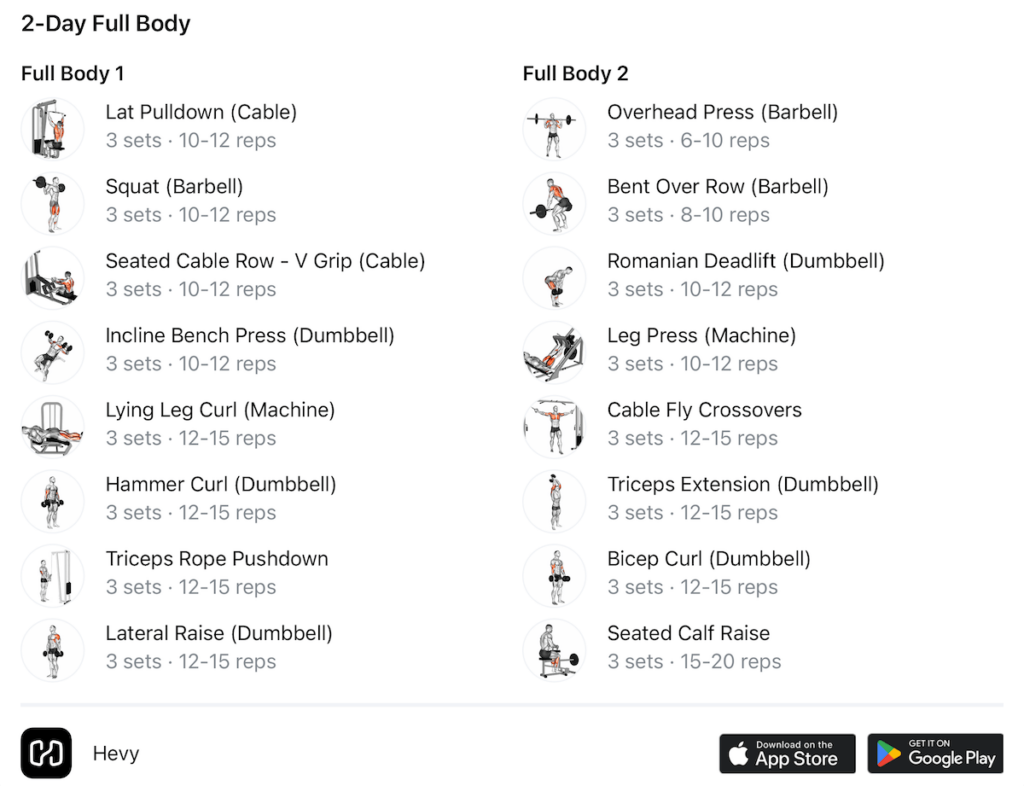
(Click here and tap the blue Save Folder button to save this split to your Hevy profile.)
Schedule
Monday – Full Body
Tuesday – Off
Wednesday – Off
Thursday – Full Body
Friday – Off
Saturday – Off
Sunday – Off
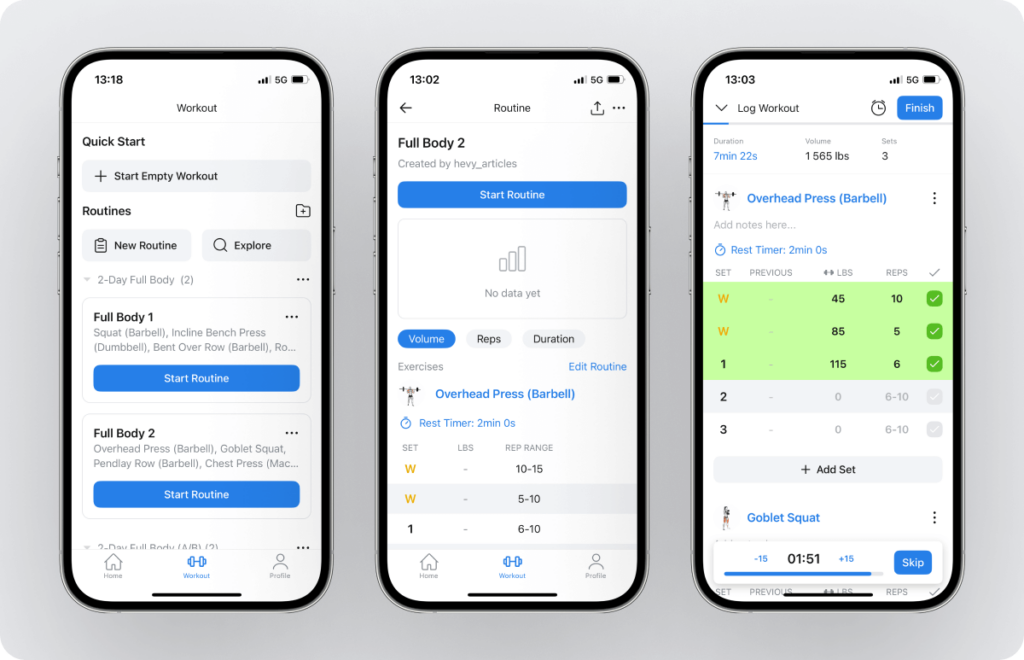
Hypertrophy
A muscle-building program typically includes more weekly sessions to ensure good volume allocation, adequate frequency, and recovery for each muscle group. However, a 2-day split can also work, provided you structure your workouts effectively.
We’ve shared a couple of full-body workouts below, adjusted for hypertrophy training. Both sessions consist of less demanding exercises, but the overall training volume is higher. The objective is to promote hypertrophy without causing excessive fatigue.
Level: Intermediate
| Day 1: Hypertrophy | Day 2: Hypertrophy |
| Chest Press (Machine) 3 sets of 10 to 15 reps Bent Over Row (Barbell) 3 sets of 10 to 12 reps Leg Press (Machine) 3 sets of 10 to 15 reps Seated Shoulder Press (Machine) 3 sets of 10 to 15 reps Glute Ham Raise 3 sets of 10 to 15 reps Chest Fly (Machine) 2-3 sets of 15 to 20 reps Seated Row (Machine) 2-3 sets of 12 to 15 reps Leg Extension (Machine) 2-3 sets of 12 to 20 reps Standing Calf Raise (Machine) 2-3 sets of 15 to 20 reps | Shoulder Press (Dumbbell) 3 sets of 10 to 12 reps Bulgarian Split Squat 3 sets of 10 to 15 reps (per leg) Inverted Row 3 sets of 5 to 15 reps Incline Chest Press (Machine) 3 sets of 12 to 15 reps Lying Leg Curl (Machine) 3 sets of 12 to 15 reps Lateral Raise (Dumbbell) 2-3 sets of 15 to 20 reps Triceps Rope Pushdown 2-3 sets of 12 to 20 reps Bicep Curl (Machine) 2-3 sets of 12 to 20 reps Face Pull 3 sets of 15 to 20 reps |
Modifications
The hypertrophy split is similar to the full-body one, but the difference is that you’re doing more assistance and isolation movements while training with lighter weights for more reps. One modification you can make is to introduce some heavier sets at the start of each workout.
Doing so can help build more strength and provide the necessary overload for optimal muscle gain. For example, lift more weight during the chest press and bent-over row, doing 6 to 10 reps per set, then proceed with Day 1 as outlined.
You can also switch some movements if you don’t have the necessary equipment. For instance, leg extensions are an excellent isolation movement for the quadriceps, but you can do lunges, split squats, step-ups, or bodyweight squats instead.
As with all other 2-day workout splits, you can change your training schedule so long as you have at least a day of recovery.
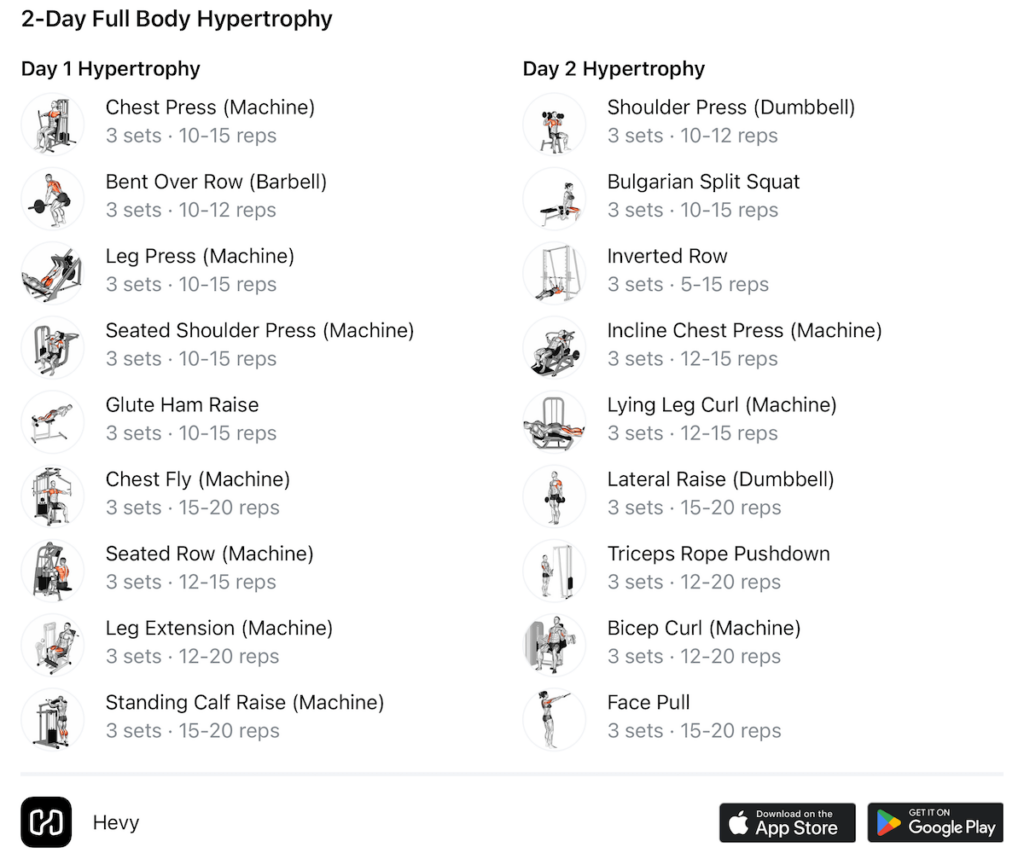
(Click here and tap the blue Save Folder button to save this split to your Hevy profile.)
Schedule
Monday – Full Body
Tuesday – Off
Wednesday – Off
Thursday – Full Body
Friday – Off
Saturday – Off
Sunday – Off
Bodyweight
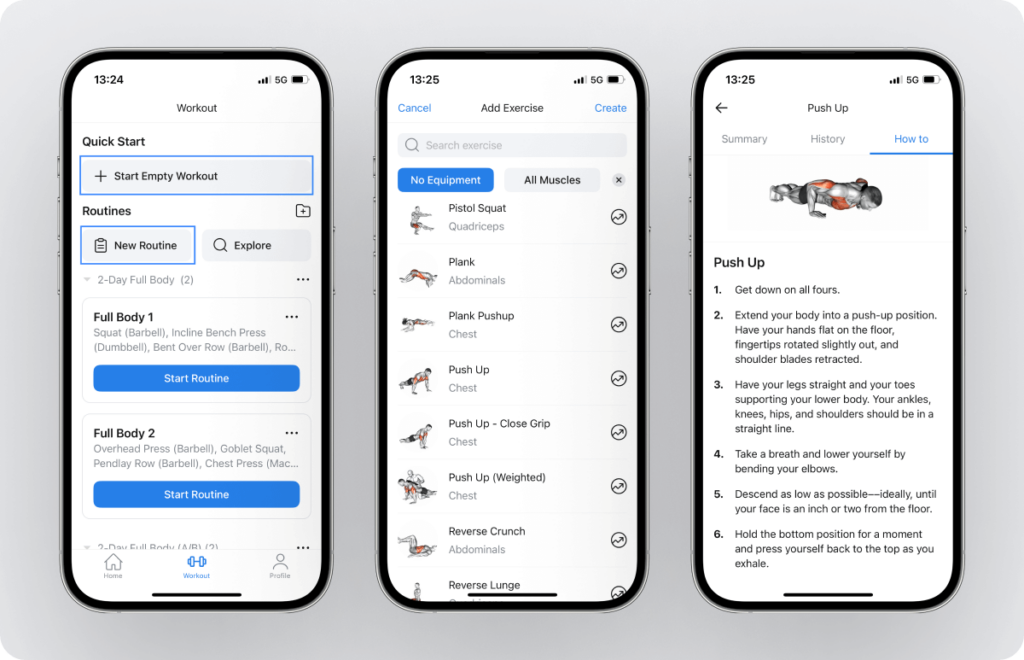
Bodyweight training is a viable option for those who want to train at home or on the go. You can pick from countless exercises and variations to create workouts that fit your athletic level and preferences. The Hevy app’s exercise library has over 400 exercises with how-to instructions, additional useful information, and demo animations.
Level: Beginner/intermediate
| Day 1: Bodyweight | Day 2: Bodyweight |
| Pull Up 3 sets of 5 to 15 reps Push Up 3 sets of 5 to 25 reps Bulgarian Split Squat 3 sets of 5 to 20 reps (per leg) Pike Pushup 3 sets of 5 to 15 reps Single Leg Hip Thrust 3 sets of 6 to 15 reps (per leg) Inverted Row 2-3 sets of 5 to 20 reps Jump Squat 2-3 sets of 10 to 25 reps Single Leg Standing Calf Raise 2-3 sets of 15 to 30 reps (per leg) | Pike Pushup 3 sets of 8 to 20 reps Assisted Pistol Squat 3 sets of 5 to 15 reps (per leg) Chin Up 3 sets of 5 to 15 reps Decline Push Up 3 sets of 5 to 20 reps Nordic Hamstring Curls 2-3 sets of 5 to 15 reps Inverted Row 2-3 sets of 5 to 15 reps Bench Dip 2-3 sets of 8 to 20 reps |
Modifications
The beauty of bodyweight training is that you can adjust all variables to suit your needs, goals, and fitness level. An obvious modification you can make is with the exercises you do. Almost all bodyweight movements have easier and more challenging variations.
For example, if regular push-ups feel too easy, try decline, plyometric, weighted, or one-arm push-ups. Conversely, if push-ups feel too difficult, do knee or wall push-ups to build strength. The same goes for other movements like squats, pull-ups, and dips.
You can also change which days you train, adjust the training volume, and experiment with different exercises to fine-tune the intensity. For example, instead of doing sets of 10 reps on chin-ups, attach a weight to yourself and do 5 reps at a time.
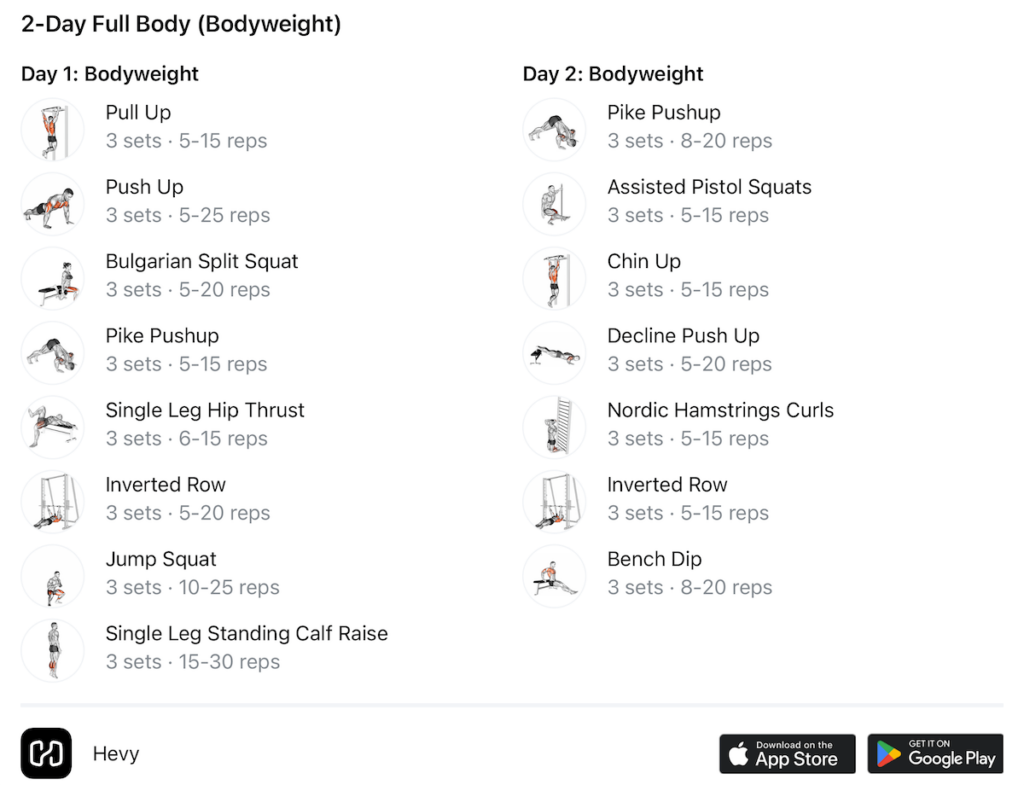
(Click here and tap the blue Save Folder button to save this split to your Hevy profile.)
Schedule
Monday – Off
Tuesday – Bodyweight workout
Wednesday – Off
Thursday – Off
Friday – Bodyweight workout
Saturday – Off
Sunday – Off
Importance of a Workout Plan and Rest Days
Having a specific workout plan helps you know what you’ll do each week, which in turn motivates you to stay consistent. Plus, you feel more accountable because you will see what you’re missing if you decide to skip a workout.
The next benefit of having a workout plan is having clearly outlined rest days. These are essential for giving your body the time to recover from the demanding training and adapt positively. Training daily might seem like a great idea, but it leaves you no time to recover and increases the risk of overtraining or injury.
Taking rest days doesn’t necessarily mean sitting on the couch all day. You can stretch your muscles, go for a walk, and do some light cardio.
Explore Hevy’s routine library for 25+ training programs and individual workouts split into categories like travel, home, equipment-free, and HIIT. See each plan’s details and save the one you like to your profile to edit and use anytime.

Combining Muscle Groups for the 2-Day Split
Back, Bicep, and Legs
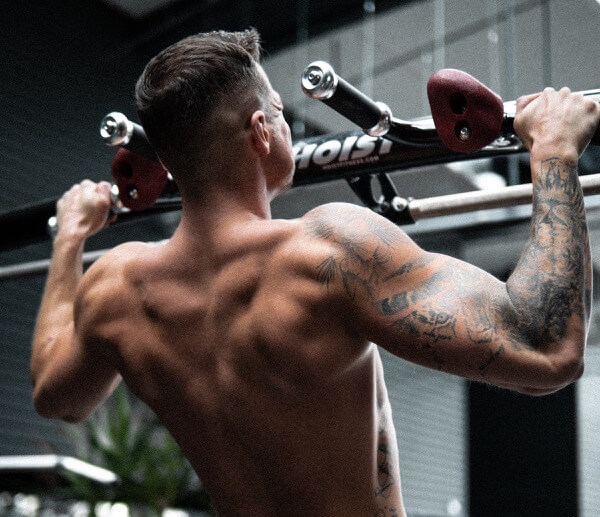
Training back and biceps is a common approach, and you can include some leg exercises if you only train twice a week. The objective would be to do your back and leg exercises first and spend most of your training on these two areas. You can then conclude the workout with some biceps isolation exercises.
Chest, Shoulders, and Triceps
The chest, shoulders, and triceps work together on various exercises, such as the bench press, so training them in the same workout makes sense. You should spend most of your time on chest and shoulder exercises and finish the workout with some triceps isolation work.
Full Body
Full body training provides many options for putting together workouts, and you can prioritize any muscle group or exercise. You can start with a movement for the back, chest, shoulders, or legs.
Don’t do too many exercises, and pick easier movements as the workout progresses. For instance, start with deadlifts and finish with leg curls, lateral raises, chest flies, or similar exercises.
You can learn more about full-body and split routine training in our article. Understand the unique pros and cons of each and which makes more sense for you.
Is the 2-Day Split Workout for Me?
Here are a few scenarios in which a 2-day split makes sense:
- Beginner – if you’re new to training, starting with two weekly workouts is a good way to get comfortable with the gym, build a habit, gain momentum, and make some newbie gains.
- Busy – if you can’t make it to the gym more than twice a week or you often miss workouts on a higher-frequency split, it would make sense to plan two workouts and stick to them.
- Athlete/active person – if you spend a lot of time and energy training for a sport or you simply want to be well-rounded and enjoy different activities, you can follow a 2-day split. It’s a great way to make progress, boost your overall fitness, and not live at the gym.
- Losing fat – this comes down to being in a calorie deficit, eating enough protein, and doing some resistance training (5, 6, 7). Whether you’re a beginner or more advanced, two workouts can be enough to provide the muscle stimulus needed to maintain lean mass while losing fat.
You can lift more weight on compound lifts to maintain strength better and keep your isolation work the same as when you’re building muscle: moderate reps (12+), average rest (1:30-1:45), and a focus on good form and an even tempo.
Now, here are a couple of scenarios where a 2-day split would not be ideal (but still better than nothing):
Goal: Build Muscle
Optimal muscle growth relies on several things. Do enough sets and reps to create a stimulus, recover well between sets, avoid excessive training to failure, and train all major muscle groups one to three times per week (2, 4, 8, 9).
A 2-day split isn’t optimal for muscle gain, since each workout needs to be quite long. You can do a couple of full-body workouts per week if that’s your only option. Pick less demanding exercises (e.g., lat pulldowns instead of pull-ups), do more reps, and do enough sets. We’ve shared a sample hypertrophy program above, or try Gironda’s 8×8 program.
Goal: Get Stronger
Training twice a week isn’t ideal for strength gain because progress occurs best when practicing compound lifts more frequently. Even if you have two full-body workouts, you will still need to do various compound exercises, which can lead to recovery issues and progressively worse performance.
You can still get stronger on a 2-day split, but understand that such a low-frequency approach isn’t ideal if you want to lift the most weight possible.
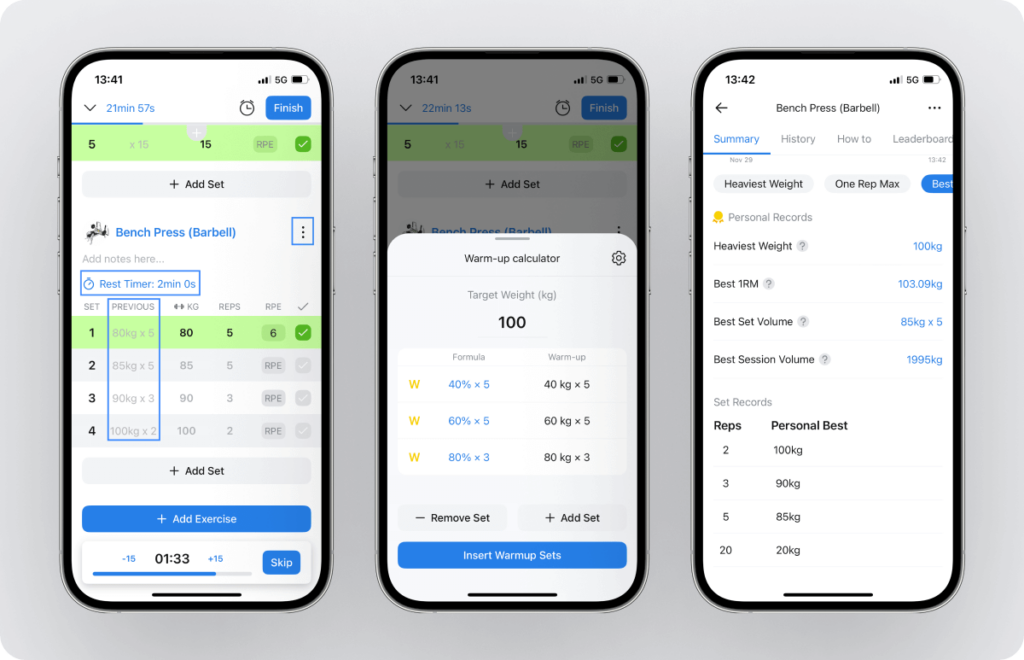
Speaking of getting stronger, here are some Hevy app features to help you in your pursuit:
- Automatic rest timers that trigger when you mark sets as complete
- Previous workout values to easily see the load and reps you did last time
- Warm up set calculator to add as many warm-up sets as needed with just one tap
- Plate calculator to see what plates you can use with your barbell to achieve a specific weight (e.g., 300 lbs)
- Live PR notification to see new personal best performances in real-time
- Exercise performance metrics to monitor your progress on the lifts that matter most
Final Thoughts on the 2-Day Split
The 2-day split is a simple and practical solution that works well for beginners and those with a tight schedule. Despite the low frequency, a 2-day split offers numerous scheduling options, allowing you to experiment with different workout styles.
Create your 2-day split routine with Hevy or save any of the above programs to your profile and start logging them.
FAQs
1. What is the best 2-day split to maximize muscle gain?
Full body twice a week is likely the best option. You get to train all muscles twice per week and can split your weekly sets better than with upper/lower. One downside is that both workouts would be long and demanding if you want to do close to the recommended 10+ sets per muscle.
2. How do I make the most of a 2-day split?
Doing only two workouts means recovery is less of an issue. To make the most of it:
- Have at least a day of recovery between the workouts
- Push close to failure on each set
- Focus on proper form and train through a full range of motion
- Don’t gloss over the accessory/isolation work at the end of your workout (when you’re tired and want to go home)
3. Can a 2-day split still work if my sessions are limited to 45–60 minutes?
Yes. You can maximize each workout by focusing on compound lifts that target multiple muscles simultaneously. Instead of doing multiple isolation exercises, you can get a similar training stimulus from one or two movements like the squat, bench press, and bent-over row.
4. How do I manage soreness so it doesn’t ruin my second workout of the week?
The best thing you can do is give yourself at least a day or two of recovery between workouts. For instance, if you do your first workout on Monday, do the second one on Wednesday or Thursday. Adjust as needed and push back the second workout by a day if you still feel very sore.